
Contents (10)
- Species or strain: what's the difference?
- The 5 most famous magic mushroom species at a glance
- Psilocybe cubensis
- Panaeolus cyanescens
- Psilocybe cyanescens
- Psilocybe semilanceata
- Psilocybe azurescens
- How to tell magic mushroom species apart
- Which magic mushroom species can you grow at home?
- Frequently asked questions
Species, strains, habitats and spore prints – reading time about 8 minutes
In this guide: There are well over a hundred magic mushroom species, but only a handful are well known. You'll meet the five most famous ones, learn where they grow and see how you can tell them apart.
Moreover, you'll find out why a species is not the same as a strain, and which magic mushroom species you can actually grow at home.
Species or strain: what's the difference?
Let's clear up the biggest source of confusion first. A species is a group of mushrooms that biologists recognise as one kind, such as Psilocybe cubensis. A strain, on the other hand, is one line of genetics within that species. Golden Teacher, B+ and PES Hawaii, for example, are all strains of the same species.
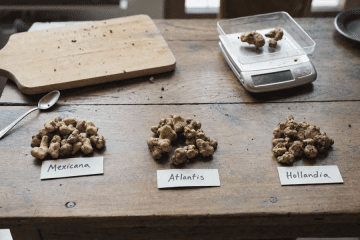
So when you compare Golden Teacher with Mexicana, you're comparing two strains. However, when you compare cubensis with Panaeolus cyanescens, you're comparing two magic mushroom species. They grow differently, look different and even have a different balance of active compounds. Want to dive into the strains? Then read our overview of Psilocybe cubensis strains.
The 5 most famous magic mushroom species at a glance
| Species | Nickname | Grows on | Spore print | Grow at home? |
|---|---|---|---|---|
| Psilocybe cubensis | Cubes | Dung, rich pasture soil | Purple-brown | Yes, the easiest |
| Panaeolus cyanescens | Copelandia, pan cyan | Dung in warm pastures | Jet black | Yes, needs warmth |
| Psilocybe cyanescens | Wavy caps | Wood chips | Purple-brown | Outdoors |
| Psilocybe semilanceata | Liberty cap | Decaying grass roots | Purple-brown | Rarely |
| Psilocybe azurescens | Flying saucer | Wood chips, sandy soil | Dark purple-brown to black | Outdoors |
Psilocybe cubensis
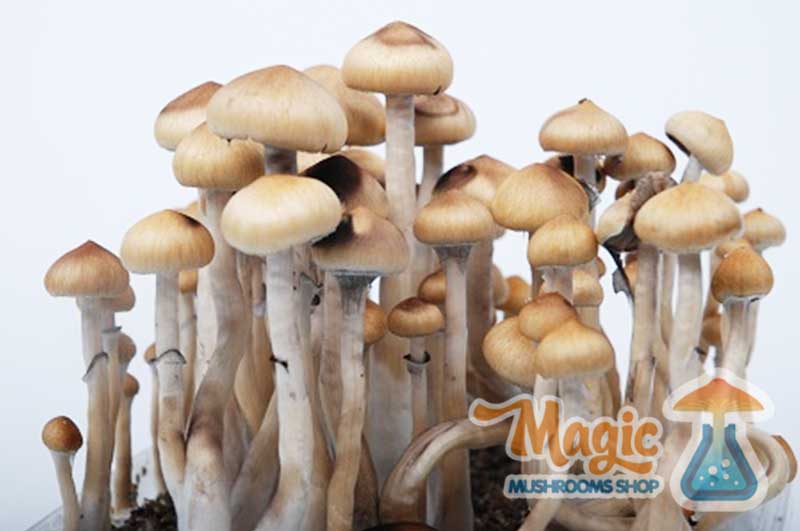
Psilocybe cubensis is the magic mushroom species most people picture. American mycologist Franklin Sumner Earle first described it in 1906 as Stropharia cubensis, from a collection made in Cuba.
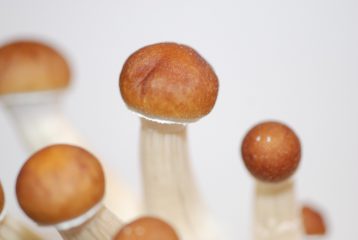
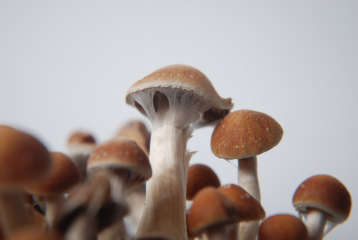
In nature, cubensis grows on cow and horse dung in tropical and subtropical regions all over the world. It has a golden to caramel cap, a ring on the stem and a purple-brown spore print. According to Wikipedia, it's the best-known psilocybin mushroom because of its wide distribution and ease of cultivation.
That ease is exactly why almost every beginner starts here. Cubensis is forgiving, grows fast and comes in dozens of strains. Read our Psilocybe cubensis guide for the full profile.
Panaeolus cyanescens
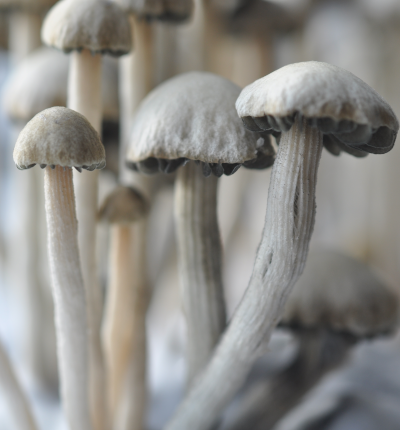
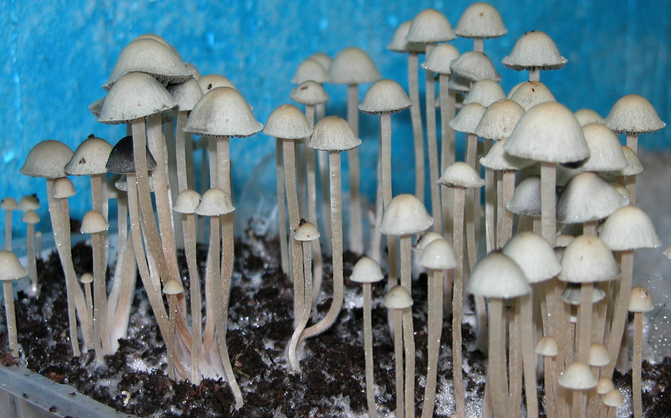
Panaeolus cyanescens is also known as Copelandia cyanescens, or simply pan cyan. It's a small, slender mushroom with a pale cap that often cracks as it dries. The gills turn black, and so does the spore print. Like cubensis, it grows on dung, but it loves warmer and more humid pastures.
In lab tests, this species often shows high levels of psilocin, whereas cubensis usually contains more psilocybin. Origin matters a lot, though. In a study of 70 collections, Stijve (1992) found that only the Hawaiian samples were also rich in psilocybin.
Because pan cyans deserve more than one paragraph, we wrote a separate guide. Our complete Panaeolus cyanescens guide covers identification, lab data, strains and growing tips. Curious about the classic Hawaiian strain? Go straight to the Hawaii section.
Watch the names: Panaeolus cyanescens and Psilocybe cyanescens share a second name, but they're completely different magic mushroom species. One grows on dung in the tropics, while the other grows on wood chips in cooler climates.
Psilocybe cyanescens
Psilocybe cyanescens is the wood lover of this list. British mycologist Elsie Wakefield described it in 1946 from a specimen she found at Kew Gardens in London. Its nickname, wavy caps, comes from the cap edge, which turns distinctly wavy as the mushroom matures.
You'll mostly find it on wood chips in parks and mulched flower beds. It grows in the Pacific Northwest of the United States, but also in Western and Central Europe and New Zealand. In addition, it needs a drop in temperature to fruit, so it usually appears in autumn.
That makes it a perfect outdoor project. Instead of a warm grow box, you need a shady garden bed with wood chips. Our Wavy Caps outdoor grow kit gives you everything to start such a patch.
Psilocybe semilanceata
Psilocybe semilanceata is the famous liberty cap. Its small, pointed cap looks like the Phrygian cap from the French Revolution, hence the name. Elias Fries first described this magic mushroom species in 1838.
Liberty caps grow in grassland: meadows, pastures and lawns, often on moist and acidic soil. Interestingly, they don't grow on dung itself. Instead, they live on decaying grass roots. That's also why they're so hard to cultivate. In fact, almost all liberty caps you see are picked in the wild.
The species has a special place in science, too. In 1963, Albert Hofmann and Roger Heim published the first report of psilocybin in a European mushroom species, and that mushroom was the liberty cap. Want to know more about Hofmann's work? Read how psilocybin and psilocin work.
Psilocybe azurescens
Psilocybe azurescens is the youngest name on this list. The first known collection dates from 1979, near Astoria in Oregon, at the mouth of the Columbia River. Paul Stamets and Jochen Gartz formally described the species in 1995. Stamets named it after his son Azureus, a nod to the deep blue bruising of these mushrooms.
Azurescens is large for a Psilocybe, with a caramel cap and a broad, persistent bump in the centre. Its nickname, flying saucer, comes from that shape. In nature it grows on wood chips and woody debris in sandy coastal soil. Like the wavy cap, it fruits in autumn after the first cold nights.
This species is famous for the high alkaloid levels Stamets and Gartz reported. However, that doesn't make it the strongest in every sample. Our article on the strongest magic mushroom species explains what the lab data really says.
How to tell magic mushroom species apart
Identifying wild mushrooms is tricky, and some toxic look-alikes grow in the same places. Therefore, never rely on one feature alone. These are the clues experienced foragers combine:
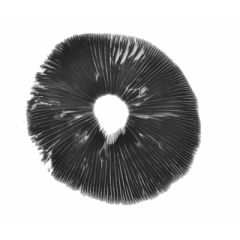
A spore print is the easiest of these tests to do yourself. Our guide on how to use a spore print shows you how.
Safety first: deadly Galerina species can grow on the same wood chips as wavy caps and azurescens. If you're not 100% sure about a wild mushroom, don't pick it. Growing your own is the safest way to know exactly what you have.
Which magic mushroom species can you grow at home?
In short: two species indoors, two outdoors and one that's best left in the field.
New to growing? First read the different ways to grow magic mushrooms at home. After that, our introduction to magic mushrooms fills in the science.
Frequently asked questions
How many magic mushroom species are there?
Well over a hundred. In a 2005 review, mycologist Gastón Guzmán counted 144 psilocybin-containing species in the genus Psilocybe alone. On top of that, there are species in Panaeolus, Gymnopilus, Inocybe and Pluteus.
Is Golden Teacher a species?
No. Golden Teacher is a strain of Psilocybe cubensis, just like B+, Mexicana and PES Hawaii.
Is Panaeolus cyanescens the same as Psilocybe cyanescens?
No. They're two different species from two different genera. Panaeolus cyanescens grows on dung in warm regions and has a black spore print. Psilocybe cyanescens grows on wood chips in cooler regions and has a purple-brown spore print.
Which magic mushroom species is the easiest to grow?
Psilocybe cubensis. That's why most grow kits contain cubensis strains.
Note: If you are suffering from a mental illness and are curious about using psilocybin or any other psychedelic therapy, please consult one of the relevant medical authorities first. Do not self-prescribe – it is vital to have the right support and guidance when using psychedelics as medicine.
Found your favourite species? Browse our magic mushroom grow kits or start with spores for your own lab.
Sources: Wikipedia – Psilocybin mushroom, Gotvaldová et al. (2022), Wikipedia – Psilocybe cubensis, Wikipedia – Psilocybe cyanescens, Wikipedia – Psilocybe semilanceata, Wikipedia – Psilocybe azurescens, Stijve (1992), Persoonia.
Updated November 20, 2026 · First published January 24, 2023
By the Magic Mushrooms Shop team · Online since 2009 · Questions? Ask our helpdesk