
You have no items in your shopping cart.

Panaeolus cyanescens: The Complete Guide to Copelandia, Pan Cyans and Their Strains
Posted under: Psilocybin Science & News
Identification, lab data, strains and growing tips – reading time about 10 minutes
In this guide: Panaeolus cyanescens is the small, pale, black-spored mushroom that growers call Copelandia or pan cyan. You'll learn where the names come from, how to recognise it, what lab research actually says about its alkaloids, and how it differs from Psilocybe cubensis.
Moreover, you'll see why one species can come in very different strains, and how to choose the right one for your grow.
| Scientific name | Panaeolus cyanescens (Berk. & Broome) Sacc. |
| Well-known synonym | Copelandia cyanescens (Berk. & Broome) Singer |
| Community names | Pan cyan, Copelandia, Hawaiian Copelandia, blue meanies |
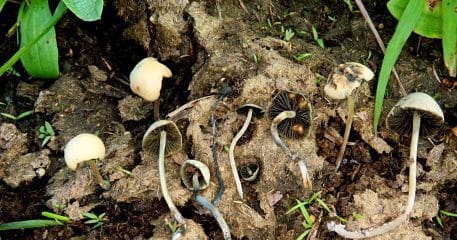
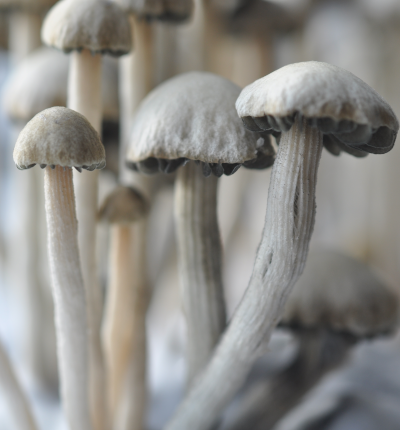
| Cap | 1.5–4 cm, light brown when young, fading to off-white or grey; often cracks |
| Gills | Grey and mottled, turning black; white edges |
| Spore print | Jet black |
| Bruising | Blue to blue-green where handled |
| Natural habitat | Dung of grazing animals in tropical and subtropical pastures |
| Main alkaloids | Psilocin and psilocybin, plus baeocystin |
What is Panaeolus cyanescens?
Panaeolus cyanescens is a dung-loving mushroom from warm parts of the world. In fact, it grows on almost every continent where cattle or water buffalo graze in a humid climate. At first sight it looks modest: a thin stem, a small pale cap and dark gills. However, it has a big reputation among growers and researchers alike.
The reason is simple. In lab tests, Panaeolus cyanescens regularly shows high alkaloid levels compared to the familiar magic mushroom species. As a result, it has become the second big name in home cultivation, right after Psilocybe cubensis.
Panaeolus or Copelandia? The name explained
You'll see two names for the same mushroom, and both are correct in their own way. The history goes like this:
Today, most databases such as NCBI Taxonomy use Panaeolus cyanescens again. Nevertheless, growers kept the name Copelandia, so you'll see both on forums and in shops. In short: Copelandia cyanescens, Panaeolus cyanescens and pan cyan all point to the same species.
Don't mix it up: Panaeolus cyanescens and its name twins
Because the names sound alike, people often confuse Panaeolus cyanescens with three other mushrooms. Here's how to keep them apart:
The nickname "blue meanies" adds to the confusion. Some people use it for Panaeolus cyanescens, while others mean the cubensis strain. Therefore, always check the Latin name before you buy anything.
How to recognise Panaeolus cyanescens
Based on the classic field description by David Arora, as summarised on Wikipedia, these are the key features:
Look-alikes
Several other Panaeolus species grow on dung as well. For example, Panaeolus antillarum looks similar but is larger and thicker, with a white cap that doesn't bruise blue. Panaeolus tropicalis, on the other hand, is a close relative that also stains blue.
Safety first: never eat a wild mushroom based on photos or a blog post. Some toxic look-alikes exist, and a wrong ID can make you seriously ill. Growing your own from known genetics removes that guesswork completely.
Where does Panaeolus cyanescens grow?
Panaeolus cyanescens is pantropical. It has been reported from Southeast Asia, India, Japan, Australia, Africa, Central and South America, the Caribbean and several southern US states, including Hawaii and Florida. In nature it fruits on old dung in warm, wet pastures.
That habitat explains a lot about how it behaves in cultivation. It loves warmth, it likes a manure-rich environment, and it fruits best under a moist casing layer.
Panaeolus cyanescens potency: what the lab data says
You'll read many bold claims online, such as "three times stronger than cubensis". However, the honest answer is that potency varies a lot by origin, strain and growing conditions. So let's look at what researchers actually measured.
What does that mean for you? First, Panaeolus cyanescens tends to be psilocin-rich, whereas cubensis usually contains more psilocybin. Second, the numbers depend heavily on the strain. That's exactly why we describe each strain separately instead of putting one number on the whole species.
Good to know: psilocin breaks down faster than psilocybin. Dry your harvest properly and store it airtight, dark and cool. Our guide on how to dry and store magic mushrooms walks you through it.
Because the alkaloid profile differs from cubensis, you can't simply swap one for the other. Our magic mushroom dosage guide has a separate Copelandia section for that reason.
Panaeolus cyanescens vs Psilocybe cubensis
If you've grown cubensis before, a lot will feel familiar. Still, a few differences matter for your grow:
| Feature | Panaeolus cyanescens | Psilocybe cubensis |
|---|---|---|
| Size | Small, slender caps and thin stems | Larger caps and thicker stems |
| Veil and ring | No veil under the cap, no ring | Veil that tears and often leaves a ring |
| Spore print | Jet black | Purple-brown |
| Temperature | Likes it warm, around 23–26 °C | Comfortable at slightly lower temperatures |
| Harvest moment | After the caps open and drop spores | Just before or as the veil breaks |
| Main alkaloid | Often psilocin-rich | Usually psilocybin-rich |
The harvest timing is the biggest surprise for cubensis growers. With pan cyans you wait until the caps are fully open, then pick. In contrast, waiting that long with cubensis is usually a mistake. Our article on when to harvest magic mushrooms explains the cubensis side.
Growing Panaeolus cyanescens at home
Growing pan cyans used to be something for advanced growers only. Fortunately, that has changed. Today you can choose between two easy routes, depending on how hands-on you want to be. And if you mainly want to study the spores, there's a third option.
1
Ready to grow: a Copelandia grow kit
Ready to grow: a Copelandia grow kit
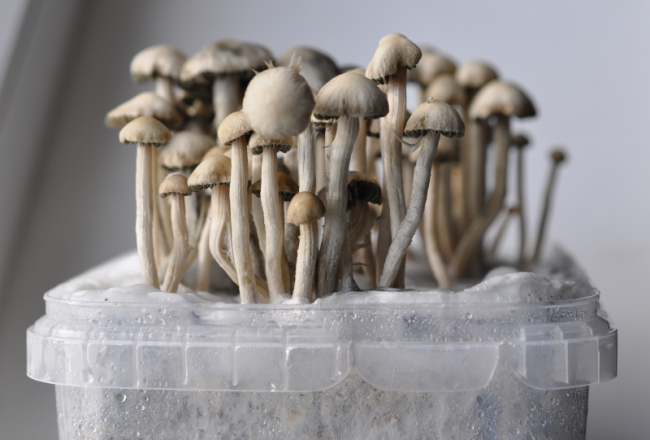
A grow kit is already fully colonised. You add the casing layer, keep it warm and moist, and wait for pins. First pins usually show up after 7–10 days at the right temperature. Our Cloud920 Copelandia grow kit instructions cover every step, from setup to the next flush.
2
Do it yourself: a liquid culture
Do it yourself: a liquid culture
Prefer to start from scratch? Then a liquid culture syringe is your best friend. It contains living mycelium, so it colonises grain faster than spores and keeps the strain true to type. The Hawaii Panaeolus cyanescens liquid culture gives you the classic Hawaiian genetics in a ready-to-use 10cc syringe. New to this? Read what a liquid culture syringe is first.
3
For collectors and microscopy: a spore print
For collectors and microscopy: a spore print
Want to study the jet-black spores under the microscope or keep the genetics in your collection? Then a spore print is the way to go. The Hawaii Panaeolus cyanescens spore print lets you see the lemon-shaped spores for yourself.
Three rules that make the difference
Panaeolus cyanescens strains
One species, many faces. A strain is a specific line of the same species, and that's where real differences show up. Some strains are wild isolates from one region. Others are hybrids that breeders crossed and selected for vigour or potency. As a result, strains can differ in speed, fruit size, yield and alkaloid profile.
At Cloud920 we treat every strain as its own product with its own story. Here's an overview of what's available now.
Hawaii
The Hawaiian strain is the classic reference for Panaeolus cyanescens. According to Allen and Merlin, the species may have reached the islands with cattle imported from the Philippines in the early 1800s. Moreover, it's the only origin in Stijve's study that was relatively rich in psilocybin as well as psilocin. You can grow it as a Hawaii Copelandia grow kit or start from the Hawaii liquid culture. Prefer to work with spores? Then the Hawaii Panaeolus cyanescens spore print gives you the jet-black spores of this classic strain.
Jamaica
Panaeolus cyanescens is widespread across the Caribbean, from Jamaica to Trinidad and Puerto Rico. Our Jamaica strain comes from that Caribbean lineage. You'll find it as the Panaeolus cyanescens Jamaica liquid culture.
More strains on the way
The pan cyan community also knows names such as TTBVI, MIB, Peace River and Estero. Some are wild isolates, while others are hybrids. We're adding more Panaeolus cyanescens strains to the Cloud920 range. Each one gets its own page, so you can compare them side by side.
Frequently asked questions
Is Copelandia the same as Panaeolus cyanescens?
Yes. Copelandia cyanescens is an older name for the same species. Most scientific databases use Panaeolus cyanescens today, but growers still use both.
What does "pan cyan" mean?
It's simply community shorthand for Panaeolus cyanescens. You'll see it a lot on forums and in grow logs.
Are pan cyans stronger than cubensis?
Lab studies often find high alkaloid levels in Panaeolus cyanescens. However, results vary a lot between origins and strains, so there's no single multiplier that's true for every mushroom.
Why don't pan cyans have a ring on the stem?
Unlike cubensis, Panaeolus cyanescens has no veil under the cap. Therefore, there's nothing to tear and leave a ring behind. It's also why you harvest once the caps have opened.
Is PES Hawaii a Panaeolus cyanescens?
No. PES Hawaii is a Psilocybe cubensis strain that shares the Hawaiian name. The Hawaiian Panaeolus cyanescens is a different species, with smaller pale caps and a jet-black spore print.
Can I grow Panaeolus cyanescens like cubensis?
Partly. The basics are the same, but pan cyans want more warmth, a casing layer and a different harvest moment. Follow strain-specific instructions and you'll be fine.
Note: If you are suffering from a mental illness and are curious about using psilocybin or any other psychedelic therapy, please consult one of the relevant medical authorities first. Do not self-prescribe – it is vital to have the right support and guidance when using psychedelics as medicine.
Ready to grow your own pan cyans? Start with the Hawaii Copelandia grow kit , pick up the Hawaii spore print or browse our liquid culture syringes.
Featured image: Copelandia cyanescens by Alan Rockefeller, CC BY-SA 4.0, cropped.
November 20, 2026