
You have no items in your shopping cart.
Hofmann's Other Discovery: How Psilocybin Was Isolated in Basel in 1958
Posted under: History & Pioneers
History & Pioneers · 20 May 2026 · 10 min read
The Hofmann psilocybin isolation is one of those moments in science that looks small on paper but reshaped a whole century of human curiosity. Specifically, in early 1958, a Swiss chemist at the Sandoz laboratories in Basel pulled a white crystalline powder out of a batch of dried Mexican mushrooms. As a result, magic mushrooms stopped being folklore. Instead, they became chemistry. Indeed, that single step changed how the West would see psychedelics for the next seventy years.
Most people who know Albert Hofmann know him for his bicycle ride. However, his discovery of LSD in 1943 was only one part of his work. Fifteen years later, in the same Basel laboratory, he isolated and named the active compounds of Psilocybe mexicana. In other words, he gave the world the molecular fingerprint of magic mushrooms.
This post tells that lesser-known story. Specifically, we trace the chain that runs from a Mazatec ceremony in 1955, through a Sandoz chromatography column in Basel, to the modern psychedelic research wave you read about today. For Hofmann's wider biography, see our full biography of Albert Hofmann.
Why the Hofmann psilocybin isolation actually mattered
Before 1958, science had a problem. Specifically, Western researchers knew that certain Mexican mushrooms produced visions. However, they did not know which molecule was responsible. Earlier attempts to identify the compound had pointed at muscarine, atropine, and bufotenin. Unfortunately, all three were wrong. Therefore, every claim about effect or dosage was guesswork built on misidentified chemistry.
The Hofmann psilocybin isolation closed that gap in a few months of work. Indeed, once Hofmann's team had pure crystals in hand, three things became possible at once. Firstly, dosage could be standardised. Secondly, the molecule could be synthesised in a clean laboratory. Thirdly, researchers could distinguish what came from the mushroom itself from what came from the ritual, the setting, or the expectations of the participant. As a result, the entire field of psychedelic research finally had a stable starting line.
For comparison, lysergic acid diethylamide had already given Hofmann a head start. Specifically, he had synthesised LSD-25 in 1938 and learned about its effects in 1943. Therefore, by the time the mushroom samples arrived in Basel, he was the most experienced chemist alive at handling psychoactive ergot derivatives. For the contrast between the two compounds, see how psilocybin and LSD differ in the body.
A note on naming. Hofmann's team did not invent the words "psilocybin" and "psilocin". Specifically, they coined them. The compounds are named after the genus Psilocybe, which itself comes from the Greek for "bare head", a reference to the mushroom's smooth cap. Furthermore, this is why every scientific paper today still uses Hofmann's original 1958 vocabulary. For more on the chemistry, see our breakdown of the chemistry of psilocybin and psilocin.
Inside the Hofmann psilocybin isolation: from Mazatec mushrooms to crystalline molecule
The story does not begin in Basel. Instead, it begins in 1955 in the small Mazatec town of Huautla de Jiménez in Oaxaca, southern Mexico. Specifically, the American banker and amateur mycologist R. Gordon Wasson travelled there with photographer Allan Richardson. Then, the curandera María Sabina invited them to participate in a night-long velada, a sacred mushroom ceremony. For the longer arc of that visit, see Wasson's first journey to Huautla.
Wasson's 1957 photo-essay in Life magazine, titled "Seeking the Magic Mushroom", brought the story to a wider audience. Subsequently, the eminent French mycologist Roger Heim, then director of the Paris Natural History Museum, joined Wasson on a later trip. Specifically, Heim identified the species used in the ceremony as Psilocybe mexicana, among others. Furthermore, Heim was able to cultivate the mushrooms back in his Paris laboratory. Then, he packaged dried samples and sent them by ordinary post to Switzerland.
This is the moment the parcel changed hands. In other words, this is where the Hofmann psilocybin isolation properly begins.
| Year | Event | Location |
|---|---|---|
| 1955 | Wasson participates in a Mazatec mushroom ceremony with María Sabina | Huautla de Jiménez, Mexico |
| 1957 | "Seeking the Magic Mushroom" published in Life magazine | New York, USA |
| 1957 | Roger Heim identifies and cultivates Psilocybe mexicana; sends samples to Basel | Paris, France |
| March 1958 | Hofmann and team publish first isolation paper in Experientia | Sandoz, Basel, Switzerland |
| 1959 | Full structure and total synthesis published in Helvetica Chimica Acta | Basel, Switzerland |
| 1960 | Sandoz markets synthetic psilocybin as Indocybin for psychiatric research | Worldwide |
| 1962 | Hofmann and Wasson meet María Sabina; she compares pills to natural mushrooms | Huautla de Jiménez, Mexico |
Step one — finding a self-test that worked
Hofmann's first move was to test the mushrooms on himself. Specifically, on a winter day at Sandoz, he ate 32 dried specimens of Psilocybe mexicana, about 2.4 grams of dry weight in total. Then, he experienced vivid Mexican-themed imagery for several hours. Importantly, this convinced him the compound survived drying and was therefore stable enough to extract. As a result, the chemistry could begin.
Step two — running the chromatography column
The team ground the dried fruiting bodies. Subsequently, they ran a series of solvent extractions, then paper chromatography to separate the active fractions. Specifically, two main spots appeared under UV light. Furthermore, both produced behavioural effects in mice and a dog at low doses. Therefore, they had two compounds, not one. Hofmann named them psilocybin (the phosphorylated, more stable form) and psilocin (the unphosphorylated, more potent but less stable form).
Step three — confirming structure by synthesis
Isolation alone was not enough. Indeed, the team also had to synthesise the molecules from scratch in the laboratory to prove the proposed structures were correct. Specifically, by 1959, Hofmann, Heim, Brack, Kobel, Frey, Ott, Petrzilka, and Troxler published the full structure and a working total synthesis in Helvetica Chimica Acta. As a result, any laboratory in the world could now make pure psilocybin without ever growing a mushroom.
From Basel laboratory to the world: Indocybin and the first wave
Sandoz did with psilocybin what it had done with LSD a decade earlier. Specifically, the company packaged the synthetic compound as a research drug under the trade name Indocybin. Furthermore, it shipped two-milligram pills, free of charge, to psychiatric institutions, neuroscience laboratories, and curious individual researchers all over Europe and North America. Therefore, by the early 1960s, psilocybin had moved from a Mexican hillside to clinics in Zurich, London, Prague, Baltimore, and beyond.
For an authoritative summary of this period, see the United Nations Office on Drugs and Crime bulletin, "Teonanácatl and Ololiuqui, two ancient magic drugs of Mexico", which records that Hofmann's Basel team confirmed dried mushrooms contained 0.2–0.4% psilocybin by weight, with only trace amounts of psilocin. In other words, the bulletin captures the moment ethnobotany and pharmacology officially met.
Hofmann himself believed he had handed the world a precise scientific tool. Moreover, as the BBC noted in a 2026 retrospective on his work, "the bizarre story of the world's first LSD trip", Hofmann kept testing both his compounds for decades. Indeed, his approach was the same throughout. First isolate. Then synthesise. Then experience. Therefore, his self-experiments were not recklessness. Instead, they were rigour.
The 1962 return to Huautla — and what María Sabina actually said
Four years after the Basel paper, Hofmann travelled to Mexico with his wife Anita. Specifically, he carried a small bottle of synthetic psilocybin pills made in his own laboratory. Therefore, the question he wanted to answer was simple. Specifically, did the pills behave the same way as the mushrooms? Furthermore, only one person in the world was qualified to give a verdict. That person was the Mazatec curandera the Mazatec curandera María Sabina.
The ceremony lasted all night. At dawn, María Sabina gave her answer. Specifically, she told Hofmann the pills contained the spirit of the mushroom. In other words, in her experience there was no difference between the natural fruiting body and the synthetic crystalline form. For Hofmann, this was the closing of a circle. Indeed, indigenous knowledge and Western chemistry had agreed in front of one another, with no translator in between.
It is also worth saying clearly what this moment was not. Specifically, it was not Western validation of an indigenous tradition. Instead, the Mazatec people had used these mushrooms for centuries without needing a chromatography column to know they worked. Therefore, the Hofmann psilocybin isolation gave the West a way to participate in a conversation. However, the conversation itself was older than Sandoz, older than chemistry, and older than the periodic table.
A note on context. The years after the Sandoz distribution were not kind to either Hofmann or María Sabina. Specifically, the surge of outsiders looking for mushrooms disrupted Huautla and contributed to María Sabina's social and financial collapse in her own village. Furthermore, Indocybin was withdrawn from the market in the mid-1960s as international regulation tightened. Therefore, the story is not a simple celebration. Instead, it is a reminder that scientific discovery has social consequences, and that those consequences fall hardest on the people who held the knowledge first.
Why this matters for today's reader
The Hofmann psilocybin isolation matters now for three concrete reasons. Firstly, every clinical trial currently running on psilocybin therapy uses dosing protocols that descend, directly, from Hofmann's 1958–1959 work in Basel. Secondly, every home cultivator who reads a strain guide is reading numbers that were first quantified on a Sandoz balance. Thirdly, the European institutional psychedelic conversation of 2026, led in the Netherlands by organisations such as OPEN Foundation, traces its intellectual lineage back to that same chromatography column.
For our readers, the takeaway is also practical. Specifically, the chain that ran from Wasson to Heim to Hofmann is now a chain that runs to your kitchen. Indeed, the same species, Psilocybe mexicana, is grown in the Netherlands today as truffles. Furthermore, the synthesis Hofmann published in 1959 means that researchers in Zurich, London, and Maastricht can study identical molecules under identical conditions. As a result, the science has caught up with the ceremony.
In other words, when you read about psilocybin in 2026, you are reading the long echo of one Basel laboratory in 1958. Therefore, knowing how that echo was made changes how you hear it.
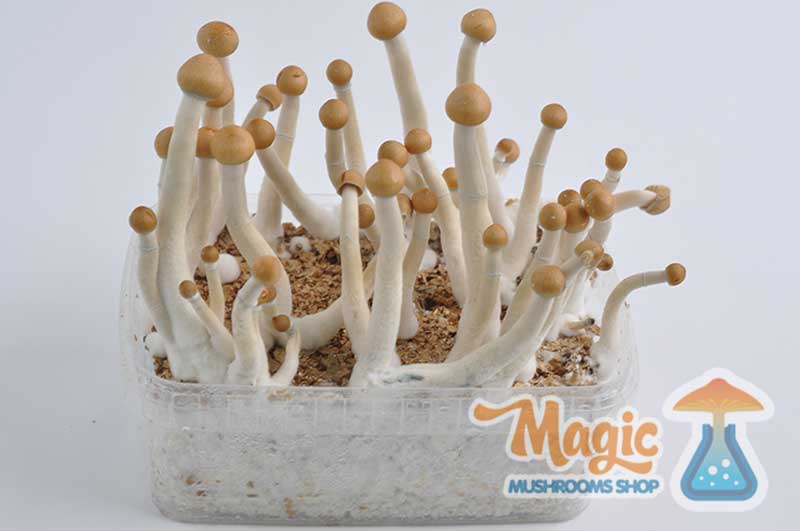
Continue the chain Wasson → Heim → Hofmann → you.
The species Hofmann analysed in 1958 is still grown today, both as truffles and as cultivated fruiting bodies. Below, three ways to step into that lineage at home, from the same Psilocybe mexicana truffles he isolated, to a modern spore vial, to a complete ready-to-grow kit.
Step into the lineage
Mexicana-A Truffles | 15 gram
 Mexicana-A—the iconic “Mellow Magic” of the truffle world—delivers lig...
Golden Teacher — Spore Vial 10ml
 Golden Teacher is the world’s most recognised cubensis spore vial — forgiving gene...
Jedi Mind Fuck Leucistic — Ready-to-Grow Bag XL — Cloud920®
 JMF Leucistic is a triple hybrid of Jedi Mind Fuck, Jack Frost, and Melmac — pale, frosty frui...
This article is for informational and educational purposes only. We share historical and scientific context so that readers can make informed, responsible decisions about what they explore. The reader is solely responsible for understanding and complying with the rules that apply to them in their own circumstances. Nothing in this post is medical or legal advice.


May 21, 2026