
You have no items in your shopping cart.

R. Gordon Wasson — The Banker Who Introduced Magic Mushrooms to the World
Posted under: History & Pioneers

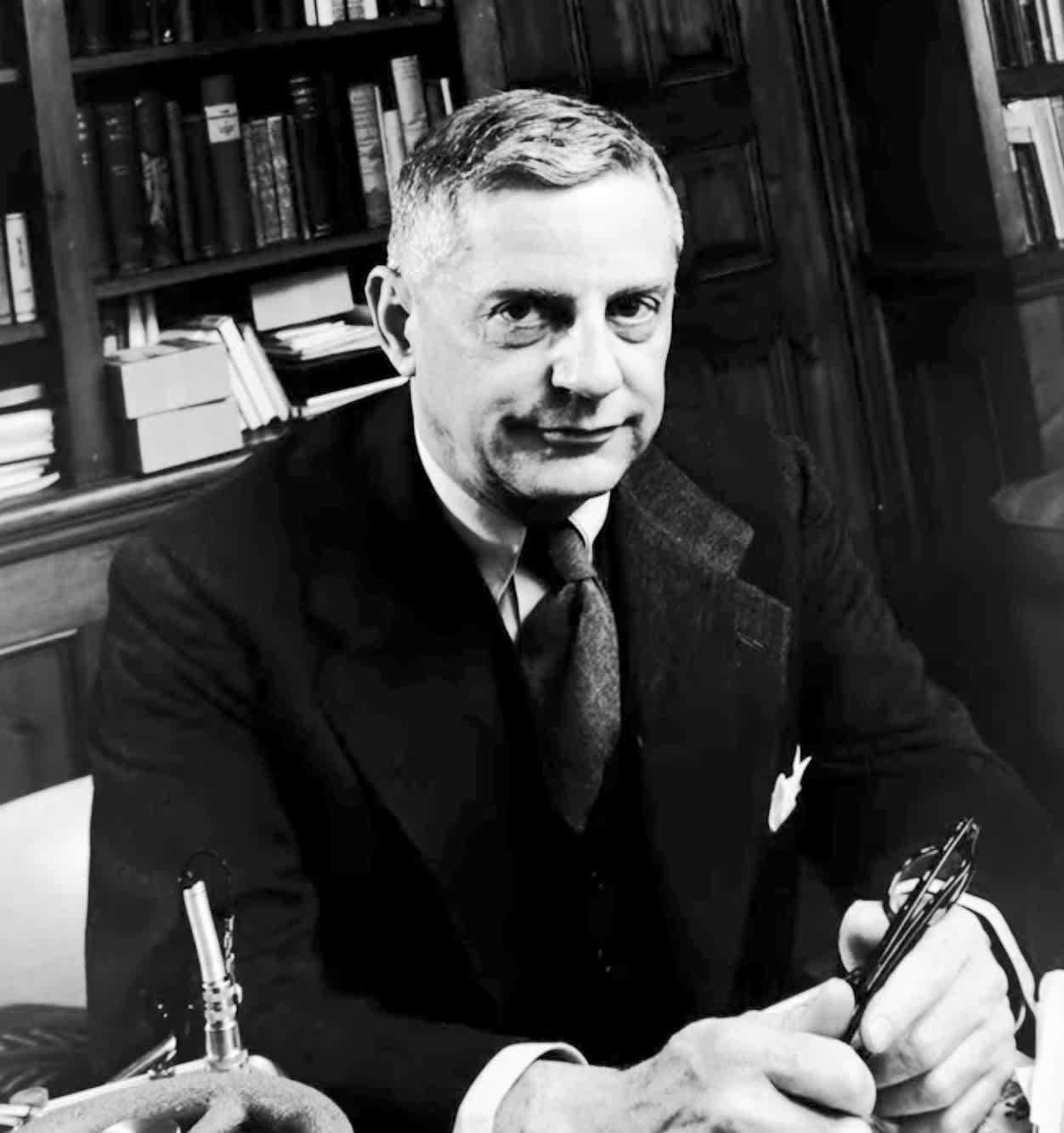
Portrait — The Man Who Introduced the World to Magic Mushrooms
R. Gordon Wasson was a New York banker. In 1955, he sat in a candlelit hut in the mountains of Mexico and ate magic mushrooms with a Mazatec healer. Two years later, he told the world about it. Nothing in mushroom culture has been quite the same since.
This is the story of who R. Gordon Wasson really was — the curiosity that drove him, the partnerships that shaped him, and the complicated legacy he left behind.
If you have ever heard the words "magic mushroom," you can trace them back to one man: R. Gordon Wasson. He was born in 1898 in Great Falls, Montana. For most of his adult life, Wasson worked as a vice president at J.P. Morgan & Co. — a world of suits, figures, and boardrooms. And yet, beneath that polished exterior, he carried one of the most profound questions a person can ask: why do mushrooms make us feel like we have touched something sacred?
A Honeymoon That Started It All for R. Gordon Wasson
The story begins, as so many great stories do, with love — and a small disagreement. In 1927, Gordon Wasson and his new wife, Valentina Pavlovna, took a delayed honeymoon in New York's Catskill Mountains. Valentina was a Russian-born pediatrician who had grown up foraging mushrooms as a child. She suddenly darted off the path and knelt in the leaves in front of a cluster of wild fungi. Then she gathered them up joyfully, planning to cook dinner.
Gordon, however, grew up in the Anglo-Saxon tradition of deep suspicion toward wild mushrooms. For him, mushrooms were things to avoid — possibly poisonous, certainly suspicious. For Valentina, in contrast, they were gifts from the forest. That single cultural difference sparked a question. The couple would spend the next three decades trying to answer it: why do some cultures love mushrooms, while others fear them?
Together, they coined two words that researchers still use today: mycophilia (love of mushrooms) and mycophobia (fear of mushrooms). Moreover, these terms became the foundation of an entirely new field of study. That field would eventually lead them far beyond Europe and into the mountains of southern Mexico.
Valentina Wasson is often overlooked in the history books. In fact, she was in many ways the driving force. She wrote most of their landmark 1957 book Mushrooms, Russia and History. In addition, her own first-person article "I Ate the Sacred Mushroom" reached 12 million readers just days after Gordon's famous Life magazine piece.
R. Gordon Wasson's Search for the Sacred Mushroom
Through the late 1940s and early 1950s, the Wassons wrote to missionaries, linguists, and anthropologists around the world. They pieced together evidence of cultures that used mushrooms in a sacred or ceremonial context. Then, in September 1952, two key letters arrived. One contained a drawing of a pre-Columbian stone mushroom carving from Guatemala. The other came from the poet Robert Graves. He pointed them toward botanist Richard Evans Schultes, who had documented the indigenous use of psilocybin mushrooms in Mexico.
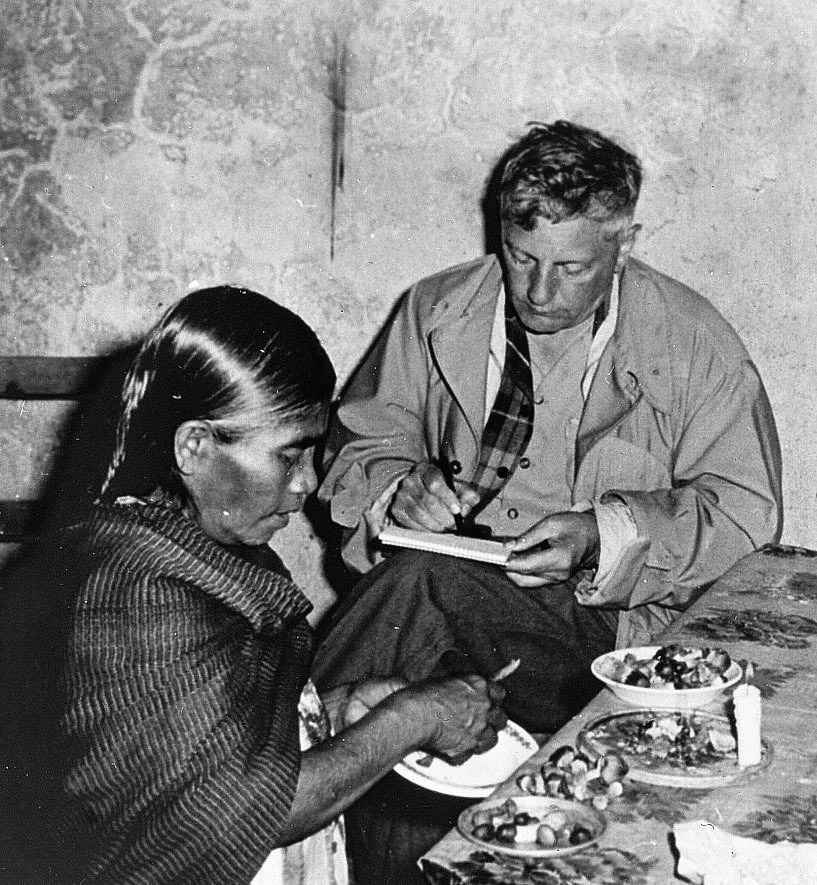
As a result, beginning in 1953, R. Gordon Wasson made several expeditions into the Sierra Mazateca mountains of Oaxaca. He searched for a community still practising the ancient velada — the nighttime mushroom healing ceremony. Finally, on the night of June 29, 1955, in the village of Huautla de Jiménez, he found what he was looking for.
One Night with María Sabina
Her name was María Sabina. She was a curandera (she preferred Sabia) — a Mazatec healer. She used sacred mushrooms, which her people called teonanácatl (flesh of the gods), to diagnose illness, locate missing people, and communicate with spirits. R. Gordon Wasson, accompanied by photographer Allan Richardson, persuaded Sabina to let them join a velada.
That night, Wasson ate the Psilocybe caerulescens mushrooms Sabina prepared. What followed stayed with him for the rest of his life. "For the first time," he later wrote, "the word ecstasy took on real meaning. For the first time it did not mean someone else's state of mind."
He returned the following year. This time, however, his expedition carried hidden funding. The CIA's MK-Ultra programme had partly financed it. The agency wanted to study whether psychedelics could serve as mind-control tools. Later, Freedom of Information Act documents confirmed that the CIA considered Wasson an "unwitting" participant. The agency hid the funding under the name of the Geschickter Fund for Medical Research.
⚠️ Wasson's access to the velada was not without ethical complications. He reportedly told Sabina he was worried about his son back home — a claim he later admitted was a deception. His publications then revealed her identity and exact location. Consequently, strangers flooded her village. Her community ostracised her, and someone burned down her home.
The Article That Named Magic Mushrooms
On May 13, 1957, Life magazine published R. Gordon Wasson's ten-page photo essay. Allan Richardson provided the photographs. French mycologist Roger Heim contributed botanical illustrations. Together, they introduced Psilocybe mushrooms to a mainstream Western audience for the very first time.

A Life editor added the title "Seeking the Magic Mushroom" — against Wasson's wishes. He felt the phrase was sensational and reductive. Even so, the term entered the language permanently. Within years, people travelled to Mexico in search of the same experience. Timothy Leary read the article and, because of this, began his own psychedelic research. The 1960s counterculture had found one of its sparks.
In later years, Wasson expressed deep regret about the consequences. The flood of outsiders into the Sierra Mazateca disrupted and ultimately damaged the very ceremonial culture he had gone there to understand.
The Science R. Gordon Wasson Set in Motion
Wasson was not a trained scientist. However, he worked closely with people who were. Together with botanist Roger Heim, he collected and identified numerous species of the genus Psilocybe. Heim then sent specimens to Albert Hofmann — the Swiss chemist who had already discovered LSD. Hofmann used them to isolate and identify the active compounds: psilocybin and psilocin. In honour of Gordon and Valentina, Roger Heim named two species Psilocybe wassonii and Psilocybe wassoniorum.
| Born | September 22, 1898 — Great Falls, Montana, USA |
| Died | December 23, 1986 |
| Career | Vice President of Public Relations, J.P. Morgan & Co. (1934–1963) |
| Field | Ethnomycology (self-taught) |
| Key publication | Mushrooms, Russia and History (1957, with Valentina Wasson) |
| Key article | "Seeking the Magic Mushroom," Life magazine, May 13, 1957 |
| Key collaborators | Roger Heim, Albert Hofmann, Carl A.P. Ruck, María Sabina |
| Named species | Psilocybe wassonii, Psilocybe wassoniorum |
Wasson and Hofmann went on to collaborate further. In 1978, together with classical scholar Carl A.P. Ruck, they co-authored The Road to Eleusis. In this book, they argued that the ancient Greek Eleusinian Mysteries used a psychedelic ergot compound in the sacred kykeon drink. The book brought three disciplines — mycology, chemistry, and classical history — into one conversation. Scholars still debate it today.
Soma and the Deeper Question
Valentina died of cancer in 1958 — just a year after their book appeared. After that, Gordon retired from banking and devoted himself entirely to research. His most ambitious theory followed in 1968. He argued that the mysterious sacred drink called soma, described in the ancient Indian Rigveda, came from Amanita muscaria — the iconic red-and-white fly agaric mushroom.
In his book Soma: Divine Mushroom of Immortality, Wasson proposed that this mushroom stood at the root of Vedic spiritual practice. In other words, he suggested that early human religion had a psychedelic origin. Many scholars disagreed. However, as a hypothesis, it opened an entirely new way of looking at the history of religion and human consciousness. Researchers still discuss it today.
Wasson's Amanita muscaria theory has not won universal acceptance. Even so, it inspired generations of researchers. For the first time, scientists began to take seriously the idea that entheogens — substances that "generate the divine within" — played a central role in the origins of human spirituality.
The Complicated Legacy of R. Gordon Wasson
R. Gordon Wasson died on December 23, 1986, at the age of 88. One obituary described him as "at home in numerous apparently unrelated fields." He was, in fact, a banker who became an ethnomycologist, a careful scholar who accidentally launched a counterculture, and a man who sought to protect indigenous knowledge — yet, in the end, helped expose it to the world.
His legacy is genuinely mixed. On one side, he founded an entire field of study. Moreover, he directly enabled Albert Hofmann to isolate psilocybin. That research today underpins the booming science of psilocybin-assisted therapy. On the other side, his actions in Mexico caused real harm to María Sabina and her community. Furthermore, the word "discovery" sits uncomfortably here — the Mazatec people had known these mushrooms for centuries.
What is undeniable, however, is that almost everything we now know about psilocybin and mental health flows, at least in part, from one rainy night in Oaxaca. That was the night R. Gordon Wasson sat down, ate the flesh of the gods, and decided the world needed to know.
Curious about the mushrooms that started it all? Explore our full range of magic truffles and grow kits — and continue the journey Wasson began.


March 15, 2026