
You have no items in your shopping cart.

Why Magic Mushrooms Make You Hallucinate: Your Brain Starts Dreaming While Awake
Posted under: Psilocybin Science & News
Psilocybin Science & News · 7 min read
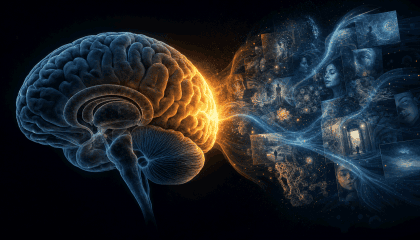
Why do magic mushrooms cause hallucinations? A 2026 neuroscience study finally has the answer — and it's as poetic as it is precise. Your brain doesn't invent hallucinations from nothing. It turns off incoming reality and starts replaying memories instead. As the lead researcher put it: "a bit like partial dreaming."
Anyone who has taken magic mushrooms or magic truffles knows the experience includes vivid visual patterns, colours that breathe, and images that appear out of nowhere. For decades, scientists knew that psilocybin — the active compound — binds to serotonin receptors in the brain. But the precise chain of events that turns a receptor interaction into a full hallucination was unknown. A new study published in Communications Biology (Nature Publishing Group) changes that. Read the original research here.
The 2026 Study That Cracked Why Magic Mushrooms Cause Hallucinations
In early 2026, a research team led by Professor Dirk Jancke at Ruhr University Bochum published a landmark study in Communications Biology (Nature Publishing Group). Using genetically engineered mice with fluorescent brain cells, they filmed the visual cortex in real time — before and after administering a psychedelic compound that targets the same serotonin receptor as psilocybin and LSD: the 5-HT2A receptor.
This technique — calcium imaging — let the team watch individual brain cells light up and go dark as it happened. No previous study had ever observed the mechanism of hallucination at the cellular level, in a living brain, in real time.
What is the 5-HT2A receptor? It's a serotonin receptor found densely throughout the visual cortex and prefrontal cortex. Psilocybin has a higher affinity for this receptor than for almost any other target in the brain. When activated, it suppresses incoming visual signals and influences learning and memory — which is precisely what makes it so interesting.
What Actually Happens: How Magic Mushrooms Cause Hallucinations Step by Step
Here is the sequence the researchers observed, step by step:
1The visual cortex gets quieter
The 5-HT2A receptor, when activated by a serotonergic psychedelic like psilocybin, suppresses the brain's response to incoming visual signals from the eyes. The visual cortex doesn't switch off entirely — it just turns the volume down on the outside world. You are still seeing, but your brain is paying less attention to it.
2Slow brain waves flood the visual system
Simultaneously, the brain starts generating stronger low-frequency oscillations at 5 Hz (theta waves) in visual areas. These are the same slow, rhythmic waves associated with drowsiness, light sleep, and dreaming. Under normal waking conditions, these waves are quiet. After the psychedelic, they amplify dramatically — both in power and duration.
3The memory hub gets activated
Those amplified 5 Hz waves travel — with a delay of approximately 18 milliseconds, consistent with a travelling wave of activity — to the retrosplenial cortex, a brain region that serves as a major hub for accessing stored memories and mental imagery. The synchronisation between the visual cortex and the retrosplenial cortex intensifies. The two regions start talking much more closely than they normally do.
4Memory fills the gap
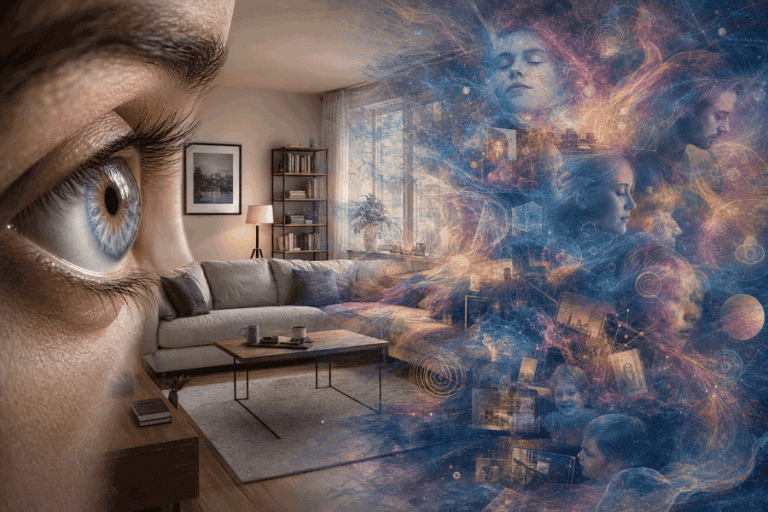
With incoming visual information suppressed and the memory network activated, the brain begins filling in missing visuals from its own internal library. Instead of reporting what the eyes are actually seeing, visual regions start projecting fragments of stored images, experiences, and patterns. These internally generated visuals blend into perception — and you experience them as real.
As Professor Jancke described it: "the experience is a bit like partial dreaming."
Important note: This study used mice and a selective 5-HT2A agonist, not psilocybin directly in humans. The mechanism is strongly consistent with human reports and supported by multiple independent lines of evidence, but direct human neuroimaging replication is still ongoing.
The Oneirogen Hypothesis: Why Magic Mushrooms Make You Dream While Awake
The Jancke study fits neatly within a broader theory formalised in April 2026 in the journal eLife: the oneirogen hypothesis. Researchers from the University of Bristol proposed that classical psychedelics — psilocybin, LSD, mescaline, DMT — cause hallucinations because they shift the neocortex into a state that closely resembles REM sleep: the phase when vivid dreaming occurs.
The Jancke study fits neatly within a broader theory published simultaneously in the journal eLife (April 2026): the "oneirogen hypothesis." Researchers from the University of Bristol proposed that classical psychedelics — psilocybin, LSD, mescaline, DMT — cause hallucinations because they shift the neocortex into a state that closely resembles REM sleep: the phase of sleep when vivid dreaming occurs.
During REM sleep, top-down signals from memory and imagination dominate over bottom-up signals from the senses. Your brain generates a fully immersive reality from within — that's a dream. Under psilocybin, the same shift occurs, but your eyes are open. You are physically awake, but perceptually you are partially dreaming.
This also explains why psilocybin hallucinations often feel so real and so structured — not like static noise or random flashes, but like scenes, faces, landscapes, and beings. Your brain is not malfunctioning. It is running its most sophisticated software — the dream engine — at the wrong time.
For a deeper dive into how psilocybin changes the brain more broadly — including the default mode network and neuroplasticity — our full neuroscience guide covers those mechanisms.
Why Understanding Magic Mushroom Hallucinations Matters for Therapy
The discovery isn't just mind-blowing — it has direct clinical implications. If psilocybin hallucinations arise because the brain enters a state of heightened memory access, then the visions aren't random noise. They are your own memories, feelings, and associations — surfaced and rendered visible.
This could explain why psilocybin therapy is so effective for conditions rooted in maladaptive memory patterns: depression (locked in negative memory loops), PTSD (trapped in traumatic memory replay), addiction (compulsive memory-driven cravings). When psilocybin activates the retrosplenial cortex and suppresses incoming reality, it may be giving the brain an opportunity to access, process, and rewrite those stored patterns.
As Professor Jancke stated: "When used under medical supervision, such substances can temporarily change the state of the brain to selectively recall positive memory content and restructure learned, excessively negative thought patterns — to be able to unlearn negative context."
This is also consistent with the growing evidence that psilocybin promotes new brain cell growth and that a single dose can produce durable changes in mood and behaviour. The hallucination isn't a side effect to be minimised — it may be part of the mechanism.
What This Means for Your Magic Mushroom or Magic Truffle Trip
Understanding why magic mushrooms cause hallucinations changes how you can approach your own experience. The visuals you see are not random — they are drawn from your own mind. This is why set and setting matter so profoundly: what you bring into the experience is what the dream engine has to work with.
If you enter a session filled with anxiety, the retrosplenial cortex may surface stressful memories and amplify them visually. If you enter in a calm, intentional state — which is the foundation of all good psychedelic practice — the memory-replay system is more likely to surface integration material, creative insight, or experiences of beauty.
This is also why the visual intensity of an experience varies so much between magic truffle doses. At low doses, the 5 Hz wave enhancement is mild — you may notice colours shifting or patterns in closed-eye visuals. At higher doses, the suppression of incoming reality becomes more pronounced, and the memory-replay system can produce fully immersive scenes.
Practical takeaway: Before a session with magic truffles or mushrooms, spend time with positive memories — music you love, photos of people you care about, places that feel safe. You are curating the library that your brain will draw from during the experience.
Magic Mushrooms and Dreaming: Ancient Wisdom Meets Modern Science
Psychedelics have been called "oneirogen" compounds — from the Greek oneiros (dream) — for decades. Now, for the first time, we have a cellular-level explanation for why. The 5-HT2A receptor is, in effect, a dream switch. When psilocybin activates it, it dials down external reality and dials up the brain's internal projection system.
A separate 2018 study published in Frontiers in Neuroscience analysed thousands of subjective reports across psychoactive substances and found that hallucinogens produced the highest similarity to dreaming of any substance tested — closer to dreams than any other drug category, including cannabis, MDMA, and dissociatives. The new 2026 mechanistic findings explain exactly why that similarity exists at the neurological level.
Magic mushrooms have been used for thousands of years — in Mesoamerican ceremonies, Mazatec veladas, and Siberian shamanic rituals. Those traditions consistently described mushroom experiences as journeys to another world — a world of ancestors, spirits, and visions. Modern neuroscience now confirms: that world is your own memory, projected by your own brain, in a state of waking dream.
It was inside you all along.
Ready to explore your inner world safely? Our magic truffle range and magic mushroom grow kits are available for legal purchase across Europe. Start with our 9-step safe trip guide before you begin.


May 7, 2026