
You have no items in your shopping cart.

New Magic Mushroom Species Discovered: The Science Behind Yellow Umbo
Posted under: Psilocybin Science & News
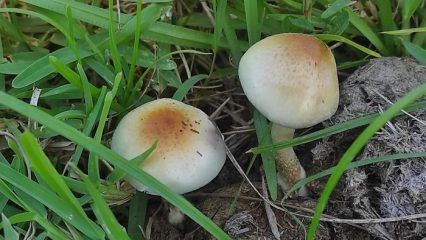
Scientists have just described a new magic mushroom species — and it turns out millions of growers have been cultivating it for years without knowing. The new magic mushroom species is called Psilocybe ochraceocentrata, and it was hiding in plain sight behind the popular names "Natal Super Strength" (NSS) and "Transkei." In other words, these were never strains of Psilocybe cubensis at all. And here at Magic Mushrooms Shop, we already carry the world's first hybrid made from this new magic mushroom species: the Yellow Umbo.
Photo: Psilocybe ochraceocentrata by Talan Moult from Stellenbosch University
The short version: A study published in Proceedings B of the Royal Society on 10 March 2026 confirms that what growers knew as NSS or Transkei is actually a separate species: Psilocybe ochraceocentrata. Moreover, our Yellow Umbo grow bag and Yellow Umbo liquid culture represent the first documented interspecies hybrid between this new magic mushroom species and P. cubensis.
| New species | Psilocybe ochraceocentrata |
| Previously known as | "Natal Super Strength" (NSS), "Transkei," "P. natalensis" |
| Published in | Proceedings B of the Royal Society, 10 March 2026 |
| Key finding | Split from P. cubensis approximately 1.5 million years ago |
| Found in | South Africa (KwaZulu-Natal) and Zimbabwe |
| First interspecies hybrid | Yellow Umbo (P. cubensis 'Jack Frost' x P. ochraceocentrata) |
What Is This New Magic Mushroom Species?
On 10 March 2026, a team of researchers from southern Africa and the United States published a groundbreaking paper in the journal Proceedings B of the Royal Society. In this paper, they formally describe Psilocybe ochraceocentrata as a new magic mushroom species. The name comes from the Latin words ochraceo (ochre yellow) and centrata (centre), because of the distinctive yellow spot in the middle of the mushroom cap.
However, this is not a mushroom that was just found in some remote forest. On the contrary, it has been cultivated by growers worldwide for many years under the popular names "Natal Super Strength" (NSS) and "Transkei." Until now, everyone assumed these were simply strains of Psilocybe cubensis — the classic magic mushroom. But as the DNA evidence clearly shows, they are an entirely separate species.
Breyten van der Merwe, a mycologist at Stellenbosch University in South Africa and co-author of the study, explained: "It is one of the most popular strains of magic mushrooms, because it is quite potent and easy to grow. But until this study, nobody realised it was a totally separate species from the classic magic mushroom."
The research was led by Dr. Alexander Bradshaw of Clark University in the United States, together with Prof. Bryn Dentinger (University of Utah Health), Dr. Keaton Tremble (Duke University), and Dr. Cathy Sharp from the Natural History Museum of Zimbabwe. The team used DNA extracted from collections across southern Africa and historic type specimens to conduct their analysis.
1.5 Million Years of Hidden History
So why does this new magic mushroom species matter beyond just a new name? Because the discovery completely rewrites the evolutionary history of magic mushrooms.
For decades, the prevailing theory was that P. cubensis originated in Africa and then spread to the Americas when European colonists brought cattle in the 1500s. After all, P. cubensis famously grows on cow dung. Therefore, the theory seemed logical: no cows in the Americas before Columbus, so the mushrooms must have arrived with them.
The new study disproves this entirely. Through genetic analysis, the researchers found that P. ochraceocentrata and P. cubensis last shared a common ancestor approximately 1.5 million years ago. To put that in perspective, this was long before humans even domesticated cattle. Consequently, the old "mushrooms hitchhiked on cows" story does not hold up.
Instead, the researchers suggest a different scenario. Around 1.5 million years ago, grasslands were diversifying in South America while grazing herbivores were migrating out of Africa into Eurasia. These ecological shifts likely created separate niches that allowed both species to evolve independently. In other words, P. cubensis was probably already present in the Americas when cattle first arrived — and then the two simply formed a mutually beneficial relationship.

Good to know: The first specimens of P. ochraceocentrata were collected in Zimbabwe back in 2013 by Dr. Cathy Sharp. However, it took over a decade of DNA analysis and collaboration between scientists on two continents before the species was formally described. This shows just how much fungal diversity remains undiscovered, particularly in Africa.
Ochras, Nats, and Cubes: What Is the Difference?
The reclassification of this new magic mushroom species has caused quite some confusion in the growing community. Therefore, let us clear things up. There are now three distinct species that growers should know about:
Here is how they compare side by side:
| Feature | Ochras (P. ochraceocentrata) | True Nats (P. natalensis) | Cubes (P. cubensis) |
|---|---|---|---|
| Previously known as | NSS, Transkei, "natalensis" | Recently correctly identified | The classic magic mushroom |
| Growth speed | Very fast, aggressive coloniser | Slower, more stable | Varies by strain |
| Appearance | Pale cap with yellow centre, wavy fruits | Brown caps, thick stubby fruits | Golden-brown caps |
| Contamination resistance | Very high | Moderate | Varies by strain |
| Experience | Strong visuals, mental clarity | Softer, cubensis-like | Varies by strain |
Yellow Umbo: First Hybrid of This New Magic Mushroom Species
Now here is where the story gets truly exciting for growers. Because P. ochraceocentrata is officially recognised as a different species from P. cubensis, any successful cross between the two counts as an interspecies hybrid — something never before documented in the Psilocybe genus.
That is precisely what the Yellow Umbo is. Created by mycologist Yoshi Amano in collaboration with Kilor Diamond, the Yellow Umbo is a cross between Psilocybe cubensis 'Jack Frost' and Psilocybe ochraceocentrata. Essentially, it combines genetics from two species that have been evolving separately for 1.5 million years.
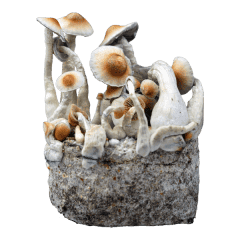 Yellow Umbo Grow Kit
How Was the Yellow Umbo Created?
Creating an interspecies hybrid is far more complex than crossing two strains of the same species. First, Yoshi Amano and Kilor Diamond isolated monokaryons (single-nucleus cells) from both parent species through a technique called serial streaking. Next, they developed novel microscopy methods to verify each step of the pairing process. Finally, the entire project was validated by Imperial Labs through interspecific verification testing to confirm that a true interspecies cross had taken place.
The Yellow Umbo that is available today has reached the F7 generation. This means it has been selected and stabilised over seven generations of cultivation. As a result, growers can expect consistent characteristics from batch to batch.
Why Is It Called "Yellow Umbo"?
The name refers to two visual features of the mushroom. "Yellow" points to the striking golden-yellow colour of the cap — inherited from its P. ochraceocentrata parent. Meanwhile, "umbo" is the mycological term for the raised bump in the centre of a mushroom cap. Together, these features make the Yellow Umbo instantly recognisable in any growing setup.
What Makes Yellow Umbo Special?
Because the Yellow Umbo combines genetics from two different species, it displays a unique blend of characteristics that you will not find in any single-species strain:
You can grow Yellow Umbo at home with our Yellow Umbo Cloud920 Ready-to-Grow Bag, which yields between 200 and 800 grams under optimal conditions (21–27°C, 90–95% humidity). For experienced growers who prefer custom substrate work, we also offer the Yellow Umbo Liquid Culture Syringe (10ml).
Good to know: Jack Frost — the P. cubensis parent of Yellow Umbo — is itself a remarkable strain. It was created around 2018 by cultivator Dave Wombat as a cross between True Albino Teacher and Albino Penis Envy. Because of this heritage, the Yellow Umbo carries strong genetics from both sides of its family tree.
Africa: Where New Magic Mushroom Species Keep Appearing
The discovery of P. ochraceocentrata is part of a larger pattern. Africa has long been one of the least studied continents when it comes to fungal diversity. Nevertheless, recent years have seen a remarkable string of Psilocybe discoveries from the region.
In 2024, for example, two other new Psilocybe species were described from southern Africa in the journal Mycologia: Psilocybe ingeli from KwaZulu-Natal and Psilocybe maluti from Free State. Both were found by citizen scientists — amateur mushroom enthusiasts who sent their finds to professional mycologists for DNA analysis. Furthermore, the research on P. maluti includes what may be the only documented first-hand account of traditional hallucinogenic mushroom use in Africa, specifically by Basotho healers in the mountain kingdom of Lesotho.
Van der Merwe emphasises the importance of citizen science in this field: "It would be impossible for a single researcher to cover a fraction of an area these mushroom enthusiasts have access to. This is the only way we will be able to further studies in African mycology." In short, Africa likely holds many more new magic mushroom species waiting to be discovered.
What Comes Next?
The story does not end with a new name on a species list. Van der Merwe is currently pursuing follow-up research to isolate and characterise the specific compounds produced by P. ochraceocentrata and related African species. Subsequently, these compounds will be tested against models for post-traumatic stress disorder (PTSD), anxiety, and depression. Given the unique chemical profile of this new magic mushroom species, this research could eventually lead to new therapeutic applications.
For the growing community, the reclassification opens new doors as well. Now that ochraceocentrata is recognised as its own species, further hybridisation experiments are likely to follow. The Yellow Umbo has already proven that crossing these two species is possible and produces stable, viable offspring. As a consequence, we may see entirely new varieties emerge in the coming years — each combining different traits from the cubensis and ochraceocentrata gene pools.
One thing is certain: we are only at the beginning of understanding the true diversity of magic mushrooms. And as growers and enthusiasts, we all play a part in that story.
⚠️ Important: Always check the legal status of psilocybin-containing mushrooms in your country before purchasing or cultivating. Laws vary significantly between jurisdictions. We encourage responsible and informed exploration at all times.
Ready to grow the world's first interspecies Psilocybe hybrid?


March 12, 2026