Contents (11)
- How do you measure the strongest magic mushroom species?
- Strongest magic mushroom species: the lab numbers
- Psilocybe azurescens: the classic number one
- Psilocybe cyanescens: the wavy cap challenger
- Psilocybe serbica and the bohemica puzzle
- Psilocybe semilanceata: small but steady
- Psilocybe baeocystis: the namesake of baeocystin
- Panaeolus cyanescens: the psilocin specialist
- Where does Psilocybe cubensis fit in?
- Why "strongest" is never one fixed number
- Frequently asked questions
Psilocybin, psilocin and why one number never tells the whole story – reading time about 8 minutes
In this guide: Which is the strongest magic mushroom species? Psilocybe azurescens usually tops the lists, but the real answer is more interesting. You'll see what lab studies measured, why results vary so much and how cubensis compares.
In addition, you'll learn why the Hawaiian Panaeolus cyanescens keeps showing up in this discussion.
How do you measure the strongest magic mushroom species?
Labs look at the active compounds in dried mushrooms. The two main ones are psilocybin and psilocin. In addition, many species contain smaller amounts of related compounds such as baeocystin.
Results are usually given as a percentage of dry weight, or in milligrams per gram. So 1% means 10 mg per gram of dried mushroom. That sounds simple. However, the numbers for one species can differ hugely between samples, and that's where most "strongest" lists go wrong.
Strongest magic mushroom species: the lab numbers
The table below combines the original azurescens data with a large modern study. In 2022, a Czech research team led by Gotvaldová analysed 226 fruiting bodies from 82 collections. Mycologist Alan Rockefeller was one of the co-authors. We converted their mg/g values to percentages.
| Species | Psilocybin (% dry weight) | Psilocin (% dry weight) | Source |
|---|---|---|---|
| Psilocybe azurescens | up to 1.78 | around 0.38 | Stamets & Gartz 1995 |
| Psilocybe serbica var. bohemica | 0.16–1.55 | 0.003–0.25 | Gotvaldová et al. 2022 (20 mushrooms) |
| Psilocybe cyanescens | 0.23–1.38 | 0.04–1.00 | Gotvaldová et al. 2022 (13 mushrooms) |
| Psilocybe semilanceata | 0.13–1.14 | 0.003–0.06 | Gotvaldová et al. 2022 (18 mushrooms) |
| Psilocybe cubensis | 0.07–0.35 | 0.02–0.53 | Gotvaldová et al. 2022 (9 mushrooms) |
| Panaeolus cyanescens | Often psilocin-rich; depends strongly on origin | Stijve 1992; Laussmann 2010 | |
Look at the ranges. Within one species, the weakest and strongest mushrooms can be very far apart. That's why the researchers concluded that "the tryptamine concentrations in mushrooms are extremely variable." In other words, the species name alone never tells you how strong one particular mushroom is.
Psilocybe azurescens: the classic number one
Psilocybe azurescens owes its reputation to Paul Stamets and Jochen Gartz. They described the species in 1995, from collections around Astoria in Oregon. In their analyses, psilocybin reached up to 1.78% of dry weight, plus psilocin and baeocystin. At the time, nothing else came close.
Want to read the original description? Shroomery hosts the azurescens taxonomy paper.
Since then, azurescens has spread far beyond the Columbia River delta. Growers keep it in wood-chip beds in gardens, also in Europe. Still, keep in mind that most of the famous azurescens numbers come from one research group. Other species can reach similar levels in individual samples, as the table shows.
Psilocybe cyanescens: the wavy cap challenger
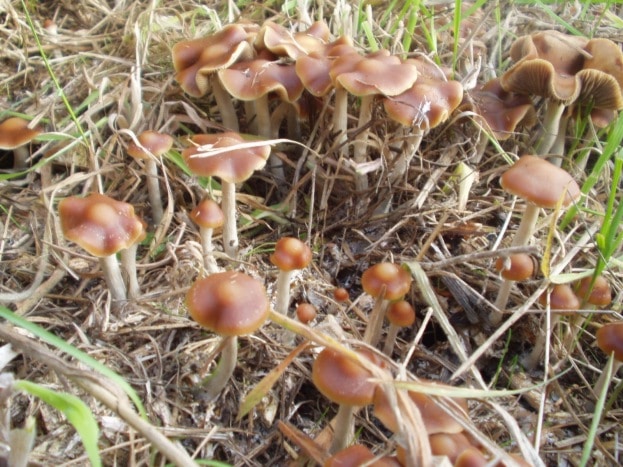
Psilocybe cyanescens, the wavy cap, is a close relative of azurescens. Both grow on wood chips and fruit in autumn. Moreover, in the 2022 study wavy caps contained a lot of psilocybin and, unlike liberty caps, also a lot of psilocin. Some growers even claim it outperforms azurescens. The data can't settle that debate, but it does put wavy caps firmly in the top group.
Good news if you have a garden: wavy caps are relatively easy to grow outdoors. Our Wavy Caps outdoor grow kit helps you set up your own patch.
Psilocybe serbica and the bohemica puzzle
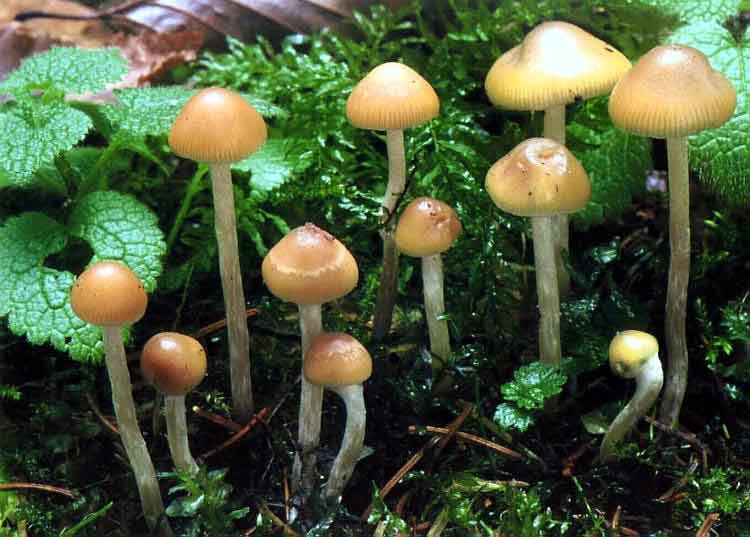
Older lists often mention Psilocybe bohemica from the Czech Republic. Czech mycologist Svatopluk Šebek described it in 1983. However, DNA research by Borovička and colleagues showed that it belongs to Psilocybe serbica. Today, its official name is Psilocybe serbica var. bohemica.
Interestingly, this variety produced the single highest psilocybin value in the 2022 study. So if you see bohemica high up in an old chart, that's no mistake. It just goes by a different name now.
Psilocybe semilanceata: small but steady
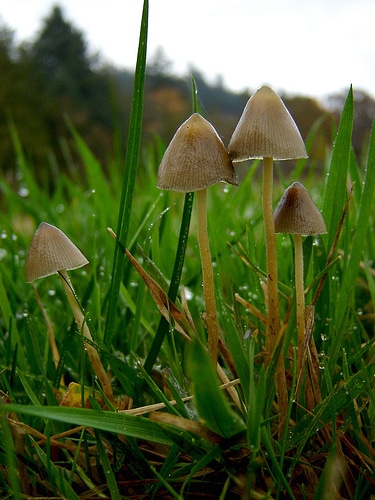
The liberty cap is tiny, yet it holds its own. It contains mostly psilocybin and very little psilocin. According to Wikipedia, studies also suggest its content varies less between countries than in many other species. In addition, smaller liberty caps tend to have higher percentages than large ones.
Psilocybe baeocystis: the namesake of baeocystin
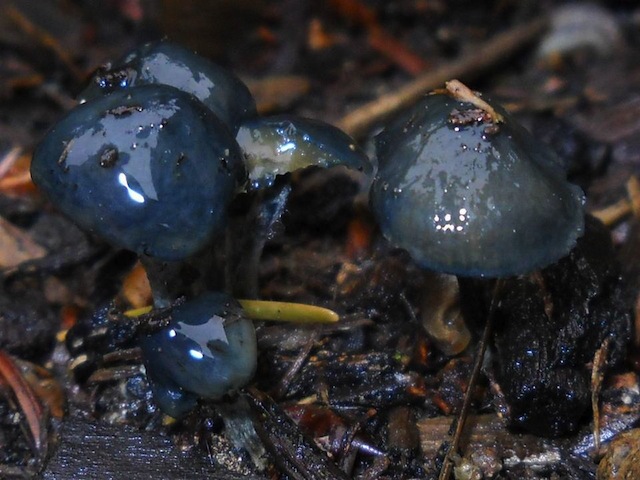
Psilocybe baeocystis is a small wood lover from the Pacific Northwest. Rolf Singer and Alexander Smith described it in 1958. You'll find it on bark, wood chips and conifer mulch, often in garden beds. Its biggest claim to fame is chemical, though. In 1967, researchers Leung and Paul discovered baeocystin in this species, and the compound was named after it.
Its psilocybin levels are moderate. According to Wikipedia, Beug and Bigwood measured 0.15–0.85% psilocybin. So it's interesting for its chemistry, but it doesn't top the strength charts.
Panaeolus cyanescens: the psilocin specialist
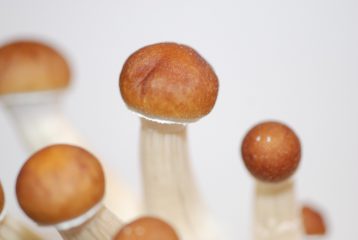
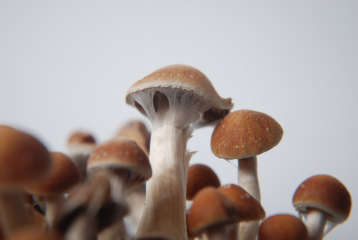
Panaeolus cyanescens, also called Copelandia, deserves a special place in this list. It isn't a Psilocybe at all, and its chemistry is different. Lab studies often find a lot of psilocin, whereas most Psilocybe species lean towards psilocybin.
So for pan cyans, origin matters even more than for most species. That's why we describe the Hawaiian line separately. Read the Hawaii section of our Panaeolus cyanescens guide for the full story.
About the name "blue meanie": some sellers call Panaeolus cyanescens "blue meanies". However, Blue Meanie is also the name of a Psilocybe cubensis strain, and some people even use it for Psilocybe baeocystis. That causes a lot of confusion, so always check the Latin name.
Where does Psilocybe cubensis fit in?
Cubensis lands at the lower end of the table. Even so, it's by far the most grown magic mushroom species, simply because it's so easy and reliable. Within cubensis, strains differ too. Penis Envy, for example, has a reputation for high potency, while B+ is known as an easy grower. Curious which strains growers rate highest? Read the strongest magic mushroom strains.
B+ — Classic Grow Kit XL — Cloud920®
 You want reliability. You want results. You want a strain that works—every single time, ...
Thinking about growing at home? First read about the different methods for growing magic mushrooms at home.
Why "strongest" is never one fixed number
Several factors change the numbers, even within one species:
Therefore, treat every "strongest" ranking as a rough guide, not a promise. For general background, our overview of magic mushroom species is a good next read.
Frequently asked questions
What is the strongest magic mushroom species?
Psilocybe azurescens has the highest classic psilocybin values. However, individual samples of Psilocybe cyanescens and Psilocybe serbica var. bohemica can reach similar levels, and Panaeolus cyanescens often stands out for psilocin.
Is Penis Envy a species?
No. Penis Envy is a strain of Psilocybe cubensis.
Can I grow the strongest species at home?
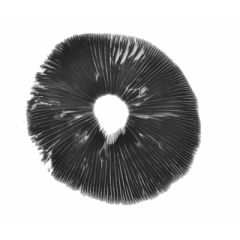
Azurescens and wavy caps grow outdoors on wood chips. Panaeolus cyanescens grows indoors, for example with the Hawaii Copelandia grow kit. For lab work there's the Hawaii Panaeolus cyanescens liquid culture, and for microscopy the Hawaii spore print.
Note: If you are suffering from a mental illness and are curious about using psilocybin or any other psychedelic therapy, please consult one of the relevant medical authorities first. Do not self-prescribe – it is vital to have the right support and guidance when using psychedelics as medicine.
Want to grow something special? Start with the Hawaii Copelandia grow kit, the Wavy Caps outdoor grow kit or browse all magic mushroom grow kits.
Sources: Gotvaldová et al. (2022), Int. J. Mol. Sci., Stamets & Gartz (1995) via Psilosophy, Borovička et al. (2011), Stijve (1992), Laussmann & Meier-Giebing (2010), Wikipedia – Psilocybe semilanceata, Wikipedia – Psilocybe baeocystis, Kristinsson (2008), Erowid, Shroomery – azurescens taxonomy paper.
Updated November 20, 2026 · First published March 23, 2026
By the Magic Mushrooms Shop team · Online since 2009 · Questions? Ask our helpdesk