
You have no items in your shopping cart.

What Is a Spore Swab? Benefits, Uses & How to Get Started
Posted under: Growing & Cultivation
Spores · Mycology · Cultivation
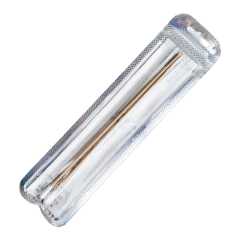
A spore swab is a sterile cotton swab pre-loaded with magic mushroom spores from a single strain. Each pack contains two individually sealed swabs — open one, and it is ready to use immediately. A spore swab is the most precise and hygienic way to work with spores, and it has now replaced the spore syringe in our collection.
What is a spore swab?
A spore swab is a sterile cotton swab loaded with the spores of one specific strain. You take one out of the sealed pack, and it is ready to use immediately. No filling, no mixing, no liquid to manage. The second swab stays sealed until you need it.
Spore swabs are used for two main purposes: microscopy — loading a slide to observe spores under magnification — and agar inoculation — streaking spores onto an agar plate to germinate mycelium. Both applications benefit from the precision and cleanliness a swab provides.
Browse our full range of spore swabs, including strains like Jack Frost, True Albino Teacher, Penis Envy, Yeti, and more. Each swab comes packed sterile and is ready to use straight from the packaging.
Why swabs beat syringes
Spore syringes have been the standard for years. They work. But a spore swab is a significant step forward — and it is why we have replaced syringes with swabs in our collection.
With a syringe, you work with liquid under pressure. You need to control the dose, keep the needle sterile, avoid bubbles, and manage the risk of splashing. Any of those steps can go wrong — and when they do, contamination follows.
A spore swab removes all of that. You open the sterile packaging, pick up the swab, and touch exactly what you want to touch. One point on a petri dish. One spot on a slide. Nothing drips, nothing splashes, nothing gets where it should not be.
Good to know: Spore swabs do not contain psilocybin or psilocin. They are sold exclusively for microscopy research and educational purposes. Always check the legislation in your country before ordering. For persons aged 18 and over only.
How far one swab goes
One spore swab is enough to inoculate one large agar plate or roughly four to five small petri dishes. That gives you plenty of margin: if one plate turns out contaminated, you still have healthy plates to work with. It is also why we deliver two swabs per pack — one for your first attempt, one as backup or for a second strain batch weeks later.
The two-step agar method (recommended)
Experienced cultivators consistently get better germination rates by splitting agar work into two steps instead of streaking straight onto nutrient-rich agar.
Why two steps? Water activates the spores. On a nutrient-poor water agar plate, the spores wake up and germinate with less competition from contaminants, because there is almost nothing for bacteria or moulds to feed on. Once you see clean mycelium, you transfer it onto nutrient-rich agar (MEA) to grow it out. This staged approach gives noticeably higher success rates than going straight to MEA.
1
Germinate on water agar
Germinate on water agar
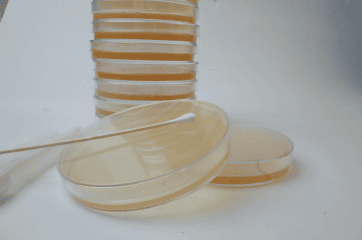
Streak the swab across a water agar plate (just agar and water, no nutrients). Water activates the spores and lets them germinate cleanly. Because there are no nutrients, contaminants have nothing to grow on either — giving your spores a head start.
2
Transfer to nutrient agar (MEA)
Transfer to nutrient agar (MEA)
Once mycelium is visible and looks clean, cut out a small piece with a sterile scalpel and transfer it to a nutrient-rich agar plate. Combine our Agar Agar powder with Light Malt Extract (LME) for the classic MEA recipe. Here the mycelium grows out fully and you can isolate the strongest sector for further work.
3
Optional: expand to liquid culture
Optional: expand to liquid culture
From a healthy MEA plate you can move a clean mycelium wedge into a liquid culture jar. Liquid culture multiplies your mycelium fast and gives you many inoculation shots from a single agar plate — ideal for scaling up to grain or substrate.
Timing and temperature: Growth on agar typically takes 10 to 20 days. Keep your plates at 25–28 °C — this is the ideal range for both germination and healthy mycelial growth. Cooler temperatures slow things down; hotter risks stressing the culture.
Step-by-step: your first inoculation
You do not need a laboratory to use a spore swab successfully. A still-air box and basic hygiene are enough for most applications.
1
Prepare your environment
Prepare your environment
Work inside a still-air box or near a laminar flow hood if you have one. Wipe down all surfaces with isopropyl alcohol (70%). Wash your hands thoroughly and put on gloves if available.
2
Prepare your agar plate or slide
Prepare your agar plate or slide
If you are inoculating agar, have your prepared petri dishes ready and warmed to room temperature. For the two-step method, start with a plain water agar plate; you can also go directly to a nutrient-rich medium made from our Agar Agar powder combined with Light Malt Extract (LME) — the classic MEA recipe trusted by cultivators worldwide. If you are doing microscopy, prepare a clean glass slide with a drop of distilled water.
3
Open the swab packaging
Open the swab packaging
Peel open the sterile wrapper inside your clean environment. Handle only the handle end — do not touch the cotton tip. The tip is where the spores are.
4
Inoculate
Inoculate
For agar: open the petri dish slightly and streak the swab tip in a zigzag or S-pattern across the surface. One swab covers one large plate or four to five small plates. For microscopy: gently roll the tip across the drop of water on the slide, then add a coverslip.
5
Seal, label and incubate
Seal, label and incubate
Close your agar plate immediately and seal with Parafilm or micropore tape. Label with the strain name and date. Store in a dark place at 25–28 °C for germination. First mycelium usually appears within a few days; full colonisation of the plate takes 10 to 20 days.
6
Store unused swabs correctly
Store unused swabs correctly
The second swab stays sealed in its original packaging. Store it cool and dry — ideally in the fridge at 2–8 °C. Stored this way, spore swabs have an excellent shelf life of many months.
Never open the swab outside a clean environment. Even briefly exposing it to unfiltered air before you are ready to inoculate increases the risk of contamination significantly.
 Swab on agar plate
Available strains — €16.50 per pack
All our spore swabs contain Psilocybe spores — the most widely studied is P. cubensis species in amateur mycology. We carry a range of well-known and exotic varieties.
Each pack contains two sterile swabs at €16.50. View the full spore swab collection.
Choosing the right spore format
A spore swab is one of four spore formats we offer. Here is a quick comparison to help you choose the right one for your situation.
| Spore swab | Direct agar inoculation or microscopy. No preparation needed. Maximum hygiene. Best for beginners and precision work. |
| Spore vial | Liquid spore suspension in a sealed vial. Good for multiple inoculations. Long shelf life. Resealable. |
| Spore print | Long-term archive format. Viable for many years when stored correctly. Most cost-efficient per strain. |
| Liquid culture syringes | Active mycelium — not spores. Fastest colonisation. Lowest contamination risk. Ready to inoculate directly into substrate. |
Browse our complete spore and liquid culture collection to find the format that suits you best.
Further reading
If you are new to agar work, these resources will help you get started. Read our guide on sterilisation and disinfection of cultivation materials and learn how to make and use a spore print. For precision work you will also need a sterile scalpel for transferring cultures from your petri dishes. For community technique tips, the Shroomery spore swab thread is a reliable external reference. You can also explore the comprehensive spore guide by Inoculate the World for background on how mushroom spores work.
Ready to get started? Browse our full range of Psilocybe cubensis spore swabs →


April 3, 2026