
You have no items in your shopping cart.

Syrian Rue (Peganum harmala): Ancient MAO Inhibitor, History & Uses
Posted under: Ethnobotanicals & Natural Highs
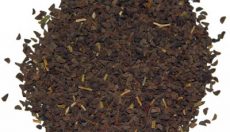
Syrian Rue Peganum harmala — ancient MAO inhibitor, 7,000 years of ritual use, and why modern science confirms what traditional healers always knew. (2026 Update)
In this guide: What Syrian Rue Peganum harmala is, its 7,000-year history of ritual and medicinal use, how its alkaloids work as MAO inhibitors, its role in ayahuasca analogues, and critical safety information you must know before considering any use.
Syrian Rue Peganum harmala is one of the most historically significant psychoactive plants in the Old World — and one of the least well-known outside specialist circles.
| Plant name | Peganum harmala |
| Common names | Syrian Rue, Wild Rue, African Rue, Harmel, Esfand, Espand |
| Plant family | Nitrariaceae |
| Active alkaloids | Harmine, harmaline, tetrahydroharmine (beta-carboline alkaloids) |
| Mechanism | Reversible MAOI — inhibits monoamine oxidase A (MAO-A) |
| Geographic origin | Middle East, Mediterranean, Central Asia; now found on five continents |
| Known use history | At least 7,000 years — confirmed by 2025 archaeological evidence |
| Buy seeds | Syrian Rue seeds (10g) · 10x Extract |
What Is Syrian Rue Peganum Harmala?
Syrian Rue Peganum harmala is a perennial, herbaceous plant with a woody underground rootstock. It grows in saline, arid soils across a broad band of territory. This stretches from the eastern Mediterranean through the Middle East, Central Asia, and into the Indian subcontinent. The plant produces small white flowers and distinctive seed capsules. The seeds contain most of the active compounds.
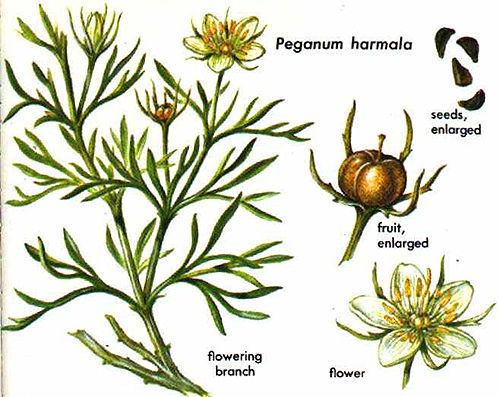
The plant goes by many names — harmel in Arabic, esfand in Persian, yüzerlik in Turkish. Each name reflects a long, intimate relationship between this plant and the communities that have lived alongside it for thousands of years. According to Wikipedia, ritual use dates back at least to the 2nd century BCE. However, earlier associations stretch back much further through literary and archaeological sources.
A History Spanning 7,000 Years
The human relationship with Syrian Rue Peganum harmala reaches back to ancient times. In May 2025, researchers published the first material evidence of Peganum harmala fumigation at an archaeological site in the Caucasus. Using HPLC–MS/MS analysis, they confirmed the presence of harmine and harmane in ancient residues. This pushed the confirmed evidence of Syrian Rue use further back than previous estimates.
The plant also appears in ancient Mesopotamian cuneiform texts. It connects to the Assyrian term šibburatu. It appears in Cappadocian tablets from around 2000 BCE. Some scholars have associated it with soma or haoma — the sacred plant drink of ancient Indo-Iranian religious texts.
The Soma/Haoma Connection
The theory that Syrian Rue Peganum harmala is the mysterious soma of the Rigveda remains one of the most debated questions in ethnobotany. A 2025 review in Ethnobotany Research and Applications noted that "the seeds of Peganum harmala contain alkaloids such as harmine and harmaline, which have psychoactive properties and are known to induce altered states." These properties align with ancient textual descriptions of haoma's visionary effects.
The MAOI properties of harmine could also enhance effects of other plants in a ritual mixture — a principle identical to how ayahuasca works in the Amazon. For more on the ancient use of psychoactive plants, see our article on shamanism and magic mushrooms.
In ancient Persia, seeds and other plant parts were burned during Zoroastrian rituals to produce dense, intoxicating smoke. This fumigation tradition survives today. In Iran, Turkey, and Azerbaijan, dried capsules are still hung in homes and vehicles to ward off the evil eye. In Kashmir, they burn at weddings. In Morocco, it is called mejnenna — "what makes you crazy, possessed."
The Active Alkaloids — How Syrian Rue Works
The primary active compounds in Syrian Rue Peganum harmala are beta-carboline alkaloids — harmine, harmaline, and tetrahydroharmine. These concentrate in the seeds. According to a comprehensive review in Pharmacognosy Reviews, seeds can contain 1.2–10% harmala alkaloids. This makes them a highly concentrated source.
These alkaloids function as reversible inhibitors of monoamine oxidase A (MAO-A). MAO-A is the enzyme that breaks down serotonin, dopamine, and norepinephrine. By inhibiting MAO-A, Syrian Rue prevents the breakdown of these neurotransmitters. This has significant pharmacological consequences.
Most importantly for psychedelic use: MAO-A normally destroys DMT before it reaches the brain when taken orally. By inhibiting MAO-A, Syrian Rue makes DMT orally active. This is the same mechanism by which Banisteriopsis caapi works in traditional ayahuasca preparations from the Amazon.
Neuroplasticity and BDNF
Recent research adds another dimension. Harmine — the most abundant alkaloid in Syrian Rue — promotes neurogenesis and neuroplasticity. A 2025 review in PMC confirmed that "harmine positively affects postnatal neurogenesis, exhibits antidepressant and anti-anxiety effects, and restores normal levels" of brain-derived neurotrophic factor (BDNF). Separate research showed that harmine restores BDNF levels and stimulates hippocampal neurogenesis in animal models of depression.
This connects Syrian Rue to the broader conversation about psychedelics and neuroplasticity. Harmine and psilocybin may share overlapping mechanisms in promoting brain flexibility.
Syrian Rue as an Ayahuasca Analogue
Since the 1990s, Syrian Rue Peganum harmala has served as a substitute for Banisteriopsis caapi in Western ayahuasca analogues. Common combinations include Syrian Rue seeds combined with DMT-containing plant materials like Mimosa hostilis bark. The resulting preparations are sometimes called "anahuasca" or "pharmahuasca."
The seeds have also been used to enhance the effects of psilocybin mushrooms and other tryptamine-containing substances. Because harmine inhibits the enzyme that breaks down psilocin, combining Syrian Rue with magic truffles can intensify and extend the experience. However, this combination significantly raises the risk profile and demands extreme caution.
Important: Combining Syrian Rue with any serotonergic substance — including psilocybin mushrooms, DMT-containing plants, or medications — fundamentally changes the pharmacology. This is not simply "more of the same." It creates a qualitatively different and more unpredictable experience. Never attempt combinations without thorough research.
Traditional Medicinal Uses
Beyond its psychoactive role, Syrian Rue Peganum harmala has an extensive history of therapeutic use. Documented traditional applications include:
Anti-Cancer Research
Modern research has confirmed many traditional uses and identified new ones. A November 2025 study found that harmine shows significant antiproliferative and antimetastatic activity against head, neck, and cervical cancer cells. Harmine induced apoptosis (programmed cell death), disrupted cell cycle progression, and reduced cell migration. The researchers concluded that harmine has potential as "a natural therapeutic agent" for further clinical development.
A separate 2025 review in Discover Oncology confirmed that harmine shows "solid antitumor potential in different types of human cancer cells." However, these are laboratory findings — not yet proven clinical treatments. Human trials have not yet been conducted.
Critical Safety Considerations
Syrian Rue's MAOI activity is pharmacologically powerful. It brings real risks that demand serious attention from anyone who considers using it.
Life-threatening interactions: Syrian Rue Peganum harmala is a potent MAOI. Combining it with certain foods (aged cheese, cured meats, fermented foods) or medications (SSRIs, SNRIs, antidepressants, stimulants, triptans, certain painkillers, MDMA) can cause a potentially fatal hypertensive crisis or serotonin syndrome. Research all interactions thoroughly before any use.
Key safety points to understand:
For broader safety guidance, our articles on set and setting and psychedelic integration cover essential preparation principles. If you want to understand the brain science behind serotonin and psychedelics, read mushrooms and the mind.
Harm reduction: If you choose to work with Syrian Rue, start with the lowest possible dose (1–2 grams of seeds). Always use a scale accurate to 0.1 grams. Never combine with other substances until you fully understand the interaction profile. Have a sober sitter present.
Syrian Rue Products at Magic Mushrooms Shop
We carry two Syrian Rue Peganum harmala products:
| Product | Contents | Use |
|---|---|---|
| Syrian Rue Seeds (10g) | 10 grams whole Peganum harmala seeds in sealed packaging | Botanical specimen, collection, incense, study |
| Syrian Rue Extract 10x | Concentrated 10:1 extract of Peganum harmala | Botanical specimen, collection, incense, study |
Both products ship from Amsterdam. Always research the relevant regulations in your country before purchasing. For our full range of ethnobotanical products, browse our Herbs of Perception collection.
Syrian Rue in the Broader Picture
Syrian Rue Peganum harmala represents one of the Old World's most important psychoactive plants. It is a counterpart to the ayahuasca vine of the Amazon. Both share chemical properties and a deep history of ritual and therapeutic use. For anyone interested in the full spectrum of psychedelic plants and substances, understanding Syrian Rue is essential.
Its alkaloids — harmine and harmaline — appear in multiple plants across different continents, including Banisteriopsis caapi and Passiflora species. This suggests a deep evolutionary relationship between these plants and mammalian serotonin systems. Researchers are only beginning to fully understand this relationship.
If the intersection of ancient plant wisdom and modern neuroscience interests you, explore our articles on how psychedelics are transforming mental health, psychedelics and addiction treatment, and microdosing for the current state of the science.
Explore our range of plant entheogens. Browse Syrian Rue seeds, magic truffles, and microdosing products — all shipped from Amsterdam.
Note: If you experience mental health challenges and feel curious about psilocybin or other psychedelic therapy, please consult a medical professional first. Do not self-prescribe. The right support and guidance matter when exploring psychedelics as medicine.


October 17, 2014