
You have no items in your shopping cart.

Pablo Amaringo: The Ayahuasca Artist Who Founded a Tradition
Posted under: Psychedelic Culture
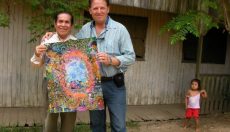
Psychedelic Artist Profile: Pablo Amaringo and the visionary world of ayahuasca art (2026 Update)
There is a moment in Pablo Amaringo's life story that captures everything about who he was. In the 1980s, when researchers Dennis McKenna and Luis Eduardo Luna visited him in the Peruvian Amazon city of Pucallpa, they found him living in poverty, barely scraping by. When they asked if he had ever considered painting his ayahuasca visions — the intensely detailed inner worlds he had witnessed as a healer — he said the thought had never occurred to him. The next day, he handed them two completed paintings. From that single spark, one of the most remarkable careers in visionary art was born.
In this profile: The life and art of Pablo Cesar Amaringo — Peruvian shaman, vegetalista, and visionary painter who almost single-handedly created a new tradition of Amazonian folk art rooted in the imagery of ayahuasca.
His paintings remain some of the most detailed and botanically accurate records of the ayahuasca visionary experience ever created.
From Healer to Artist
Pablo Cesar Amaringo Shuña was born on 21 January 1938 in Puerto Libertad, in the Peruvian Amazon. His path to healing began at the age of ten, when he first drank ayahuasca to treat a serious heart condition. The experience transformed him. He went on to train as a curandero — a traditional healer — working for decades in the mestizo tradition of healing known as vegetalismo, where plant spirits serve as guides and teachers.

Pablo practiced as a vegetalista — a healer who derives their knowledge from powerful plant teachers — for many years. He travelled across Peru, healing people in Pucallpa, Lima, Cusco, Madre de Dios, and beyond. In 1977, he made a significant decision: he gave up his healing practice and turned his full attention to painting and teaching art. He founded the Usko-Ayar school of Amazonian painting in Pucallpa, which went on to teach hundreds of young people the techniques of visionary art.
The Meeting That Changed Everything
When ethnobotanist Luis Eduardo Luna and researcher Dennis McKenna encountered Pablo in the early 1980s, they recognised immediately what they were looking at: not only a gifted artist, but a man with an extraordinary eidetic memory and an encyclopaedic knowledge of Amazonian shamanic tradition. Luna later described Pablo as "an incredibly rich source of information about the shamanic mestizo tradition."

Their collaboration resulted in the landmark book Ayahuasca Visions: The Religious Iconography of a Peruvian Shaman (North Atlantic Books, 1991). The book introduced Pablo's paintings — and, through them, the inner world of ayahuasca ceremonialism — to audiences in Europe and North America who had no previous access to this knowledge. It remains a defining work in the literature of psychedelic art and Amazonian spirituality.
Pablo also contributed to other key publications, writing the preface for Plant Spirit Shamanism: Traditional Techniques for Healing the Soul (2006), and his artwork appeared in Graham Hancock's Supernatural. He is also featured in The Shaman and Ayahuasca: Journeys to Sacred Realms (2010), a documentary film on ayahuasca healing.
The Paintings Themselves
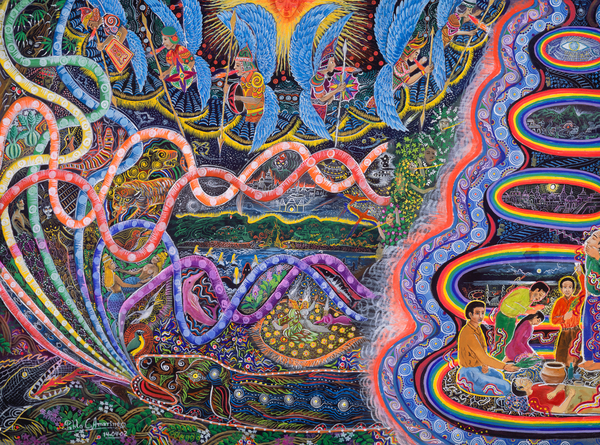
What sets Amaringo's paintings apart is their extraordinary complexity and specificity. His canvases are densely layered worlds — teeming with serpents, dolphins, jaguars, mythological beings, spaceships, shamans, and spirit entities — all rendered in brilliant tropical colours and rendered with the intricate detail of an illuminated manuscript.
These are not abstract impressions of a psychedelic state. They are, in a real sense, maps. Pablo painted exactly what he had seen in his visions, and he was famous for his ability to recall visions in perfect detail years or decades after they occurred. Each element in a painting has a specific meaning within the Amazonian cosmological framework — the plants are identifiable by species, the beings belong to recognised categories within the tradition, the geometric patterns reflect the "mareacion" (the wave-like quality of the ayahuasca experience).
In his own words, Ayahuasca is "the planta maestra — the eye through which you see the world, the universe. It is miraculous and sacred, and you can learn from your studies far more with Ayahuasca than with other plants."
The Usko-Ayar School
Perhaps Pablo's most enduring legacy is the Usko-Ayar school of painting he founded in Pucallpa. The school gave hundreds of young people in the local community access to formal art training, and some of its graduates became accomplished and internationally recognised artists in their own right. Pablo built an entirely new tradition — one where the visionary experience of ayahuasca became the foundation of a living, community-based art practice.
This is remarkable for several reasons. Amazonian visionary art has ancient roots — but before Pablo, it had no equivalent tradition of painted figurative work. He essentially founded a genre, and he did so with the practical, community-oriented mindset of a healer rather than the ego of a commercial artist.
His Legacy
Pablo Amaringo passed away on 16 November 2009, at the age of 71, still working on new paintings documenting the flora, fauna, and spiritual beings of the Amazon right up to the end. His influence on visionary art — and on how Western audiences understand ayahuasca — is difficult to overstate.
His paintings have been exhibited in museums and galleries around the world. They have inspired generations of visionary artists, from Alex Grey to countless painters working in the tradition today. And they remain, for many people who have experienced ayahuasca, the most accurate visual record of what that experience can look and feel like.
For those curious about ayahuasca and its history, our detailed guide on ayahuasca — its history, use, effects, and safety offers essential context. And for a broader look at the figures who have shaped psychedelic culture, see our profiles of Terence McKenna and María Sabina.
Inspired by Amazonian plant traditions? Learn more about magic truffles — a legal psilocybin experience available in the Netherlands.
Note: If you are suffering from a mental illness and are curious about using psilocybin or any other psychedelic therapy, please consult one of the relevant medical authorities first. Do not self-prescribe — it is vital to have the right support and guidance when using psychedelics as medicine.


October 14, 2014