
You have no items in your shopping cart.

Wavy Caps Outdoor Grow Kit Instructions by Cloud920
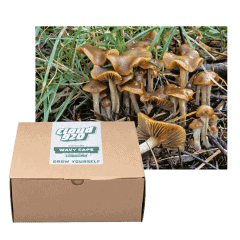
Our cultivation method is based on the Woodlovers Tek developed and popularised by Pacific Northwest mycologist Jack Cyan, adapted for European climates.
These Wavy Caps Outdoor Grow Kit instructions guide you step-by-step through starting your own outdoor patch of Psilocybe cyanescens. Follow these instructions for the Wavy Caps Outdoor Grow Kit and enjoy fresh mushrooms in your garden every autumn for years to come.
Introduction
Wavy Caps (Psilocybe cyanescens) are wood-loving (lignicolous) mushrooms that thrive in cool, moist, temperate climates — exactly what most of Western and Northern Europe offers in autumn. Unlike Psilocybe azurescens, which often refuses to fruit outside of a narrow coastal Pacific Northwest niche, cyanescens have proven themselves to be a much more forgiving and reliable outdoor species in European gardens.
This Outdoor Kit contains a 2-litre spawn bag with a fully colonised wood-chip and grain mix. The kit does not include the hardwood chips for the bed itself — you organise those yourself (see "What you will need" below). However It can be purchased optinally when buying the outdoor kit. Once mixed with your own hardwood chips and buried in the right spot, the spawn will form a permanent mycelium patch in your garden that can fruit every autumn for many years.
Best time to start: February, March or April. Patches started in spring have the highest chance of fruiting in the same autumn (September–December). Patches started after April will most likely fruit the following year.
Storage: Keep the kit in the refrigerator at 2–8°C until you are ready to use it. The colonised spawn can be stored this way for up to about 2 months without losing viability — it will simply pause growth and resume once warmed back to room temperature. Do not freeze.
Wavy Caps Outdoor Grow Kit instructions: from spawn bag to harvest
1
Prepare chips
7–14 days
Prepare chips
7–14 days
2
Inoculate
1 day
Inoculate
1 day
3
Colonise
8–16 weeks
Colonise
8–16 weeks
4
Fruit & harvest
Sept–Dec
Fruit & harvest
Sept–Dec
What you will need
Included in your Outdoor Kit:
To organise yourself:
Which wood to use
Good (hardwoods, all work well): beech, alder, oak, maple, hazel, birch, poplar, willow, fruitwood (apple, pear, cherry). Beech and alder are considered the very best for P. cyanescens.
Wood chips for animal bedding (pet shops, garden centres) are a convenient and clean source. Fresh chips from a tree surgeon also work well, as long as the species is right. Avoid bark mulch — P. cyanescens grows on wood, not on bark.
How much wood do I need?
The 2 L of spawn in your kit is enough for 20 to 40 litres of hardwood chips. There is a trade-off you can decide based on what you want:
| ~20 L (ratio 1:10) | Dense inoculation, fast colonisation, best chance of fruiting in the first autumn. Recommended for first-time growers. |
| ~30 L (ratio 1:15) | Balanced — larger patch, still good chance of first-year fruiting. |
| ~40 L (ratio 1:20) | Largest patch, more long-term yield, but colonisation takes longer and fruiting usually starts in the second year. |
For reference, 20 L of moist wood chips fills roughly a standard household bucket; 40 L is about two buckets.
Step 1 Choose the right spot
Pick the location for your patch before you open the kit. Look for:
Permission and legality: Make sure you are allowed by the owner of the land to have a mushroom patch there. Do not break the law. Cultivation and possession laws for Psilocybe cyanescens vary by country — check your local regulations before starting.
Step 2 Prepare the hardwood chips
Temperature: room temperature (15–25°C)
Duration: 7–14 days (Method A) or 12+ hours (Method B)
Ready when: chips feel moist but not wet, water smells sour
Your chips need to be hydrated and cleaned of competing organisms before the spawn goes in. For outdoor woodlover beds we strongly recommend cold-water fermentation — it is Jack Cyan's own preferred method, it is what works best in practice for Psilocybe cyanescens, and it avoids the hassle of boiling tens of litres of water.
Method A — Cold-water fermentation (recommended)
- Line a bucket or bin with a sturdy bag and place the wood chips inside.
Then fully submerge them in water. A 20-litre bucket with lid is perfect for this. - Close the lid or cover loosely and leave for 7–14 days at room temperature.
A few extra days does no harm. Warmer rooms ferment faster, cooler rooms take longer. - Watch for the signs of active fermentation.
The water will turn dark and the chips will start to smell sour or funky — this is normal and is exactly what suppresses competing moulds and bacteria. - Lift the bag out of the bucket and let it drain.
Place it somewhere it can drain (over a drain, on a slope, or over a second empty bucket). Poke a hole near the bottom of the bag and let it drain slowly for a day or two. Jack Cyan's own trick. - Check the moisture before inoculation.
The chips are ready when they feel moist but not wet — squeeze a handful and only a few drops should come out, not a stream.
Why fermentation works: during the soak, aerobic moulds and bacteria are starved of oxygen and die off; once you drain the chips, the surviving anaerobic organisms are then killed by exposure to air. What remains is a substrate that is hostile to most competitors but loved by woodlover mycelium.
Method B — Hot water pasteurisation (faster alternative)
- Place the wood chips in a clean bin or large bucket.
The container must be able to withstand boiling water. - Pour boiling water over them until fully submerged.
Make sure every chip is under water. - Cover with a lid or tarp and let cool slowly overnight.
At least 12 hours. The slow cool-down extends the pasteurisation effect. - Drain thoroughly — moist but not dripping wet.
Same moisture test as Method A: a few drops when squeezed, not a stream.
Use this method if you are in a hurry, but be aware that pasteurisation gives less of the natural selective advantage that fermentation provides for woodlovers.
Step 3 Hygiene
Step 4 Break up the spawn
Step 5 Mix spawn into the chips (lasagna method)
Jack Cyan's tek uses a layered "lasagna" method rather than a single mix — this gives the mycelium more contact points and faster colonisation.
- Dig a shallow pit in your chosen spot.
Roughly 30–40 cm wide and 10–15 cm deep, sized to hold the volume of chips you have. - Put down a base layer of fermented or pasteurised wood chips (3–5 cm).
This is your foundation. Press it gently flat. - Sprinkle a layer of broken spawn pieces across it.
Distribute evenly — don't dump it all in one spot. - Add another layer of chips (3–5 cm).
Continue building upward. - Optional: a thin sprinkle of garden soil.
It helps retain moisture during dry spells. - Repeat layers until everything is used.
Chips → spawn → chips → soil → chips → spawn, working your way up. - Finish with a top layer of pure wood chips (no spawn on top).
This protects against contamination and drying out.
Spawn-to-substrate ratio: see the table above. For first-time growers we recommend the 1:10 ratio (around 20 L of chips) — it gives the fastest colonisation and the best chance of seeing mushrooms in the first autumn.
Step 6 Cover and protect
Step 7 Wait for colonisation
Temperature: ambient (any European garden)
Duration: 8–16 weeks
Ready when: first cold snap of autumn triggers fruiting
Want everything for your patch in one order? Get the Wavy Caps Outdoor Grow Kit together with beech wood chips, a 20L fermentation bucket, sterile gloves and disinfectant.
Maintenance — taking care of your Wavy Caps patch
Moisture
Cyanescens love moisture. In dry weather:
Nutrients & refreshing the patch
The mycelium digests the wood chips, so the patch will slowly shrink each year.
Never use fertiliser, manure, pesticides, herbicides or fungicides anywhere near the patch. Even small traces can kill years of mycelium growth.
Weather protection
Harvest When and how to pick your Wavy Caps
Season: September – December
Trigger: first cold snap, temps <15°C day / 5–10°C night
Flushes: 1–3 per year
Patch lifespan: 4–6+ years with annual chip top-up
Harvest time
Wavy Caps fruit in autumn into early winter, typically:
The cold drop acts as a natural "cold shock" that tells the mycelium it is time to fruit. You can usually expect 1–3 flushes in a good year.
First year: Don't be disappointed if your patch doesn't fruit in its first autumn. Many cyanescens patches need a full year to fully colonise before producing their first flush. Once established, they typically fruit every year for 4–6 years or longer.
When do you harvest the Wavy Caps?
Pick the mushrooms when they "look mature":
How do you harvest the Wavy Caps?
- Grab the mushroom at the base, close to the wood chips.
Get as close to the substrate as you can without pulling chips loose. - Gently twist to release it from the mycelium.
Don't yank straight up — that can tear the underground network. - Pick clusters together where they come up together.
A whole cluster releases easier than picking individual mushrooms from the same root. - Brush off any debris on the spot.
Don't wash the mushrooms before drying — water shortens shelf life.
Pro tip from Jack Cyan: Trim the stem butts and toss them back into the patch (or into a new chip mix). The mycelium will regrow from them and help expand your patch.
Important warnings
Identification is critical. Only harvest mushrooms you are 100% sure are Psilocybe cyanescens. Over the years, other wild species can colonise the patch — remove anything you don't recognise. If in doubt: do not consume.
Quick reference
| Species | Psilocybe cyanescens (Wavy Caps) |
| Spawn volume | 2 L colonised wood/grain mix (included in kit) |
| Substrate | 20–40 L hardwood chips (organised by you, not included) |
| Best wood types | Beech, alder, oak, maple, hazel, birch, poplar, willow, fruitwood |
| Wood to avoid | Cedar, pine, fir, eucalyptus, walnut, bark mulch |
| Recommended spawn ratio | 1:10 (~20 L chips) for first-time growers |
| Substrate preparation | Cold-water fermentation 7–14 days (recommended) or hot-water pasteurisation |
| Start month | February – April for first-year fruiting; later starts fruit the following autumn |
| Fruiting season | September – December |
| Fruiting trigger | Cold snap, temps below ~15°C day / 5–10°C night, after rain |
| Expected flushes | 1–3 per year |
| Patch lifespan | 4–6+ years with annual chip top-up |
| Storage of unused kit | Fridge 2–8°C, up to ~2 months. Do not freeze. |
Ready to start your own outdoor patch? Order the Wavy Caps Outdoor Grow Kit and start growing Psilocybe cyanescens in your garden today.
Follow these Wavy Caps Outdoor Grow Kit instructions carefully and you can enjoy fresh Psilocybe cyanescens mushrooms from your own garden every autumn for years. Above all, patience and clean work matter most. Happy growing!


