You have no items in your shopping cart.



Yeti — Spore Swab Cloud920®
The Yeti spore swab gives you access to one of the most visually distinctive isolates in the True Albino Teacher family. Developed by Jik Fibs from the original TAT line, Yeti produces ghostly white fruits with thick, stubby stems and a bruising reaction so intense it borders on electric blue. Two individually sealed swabs, ready for agar work and comparative microscopy.
Availability: In stock
€16.50
Related





Check items to add to the cart or select all
Product Description
Details
Yeti — Origin & Genetics
Cloud920® Genetics: Hybrid Fusion
Yeti is a direct isolation from the True Albino Teacher (TAT) line — itself a spontaneous albino mutation of Golden Teacher, first discovered around 2019 by Jik Fibs of the TAT Syndicate. While TAT established the albino phenotype, the Yeti isolation pushed further: selecting specifically for the most extreme morphology within that line — shorter, denser stems, wider caps, and a bruising reaction that stands out even among other albino cubensis varieties.
That selection process took years of agar work and careful phenotype evaluation within the TAT Syndicate community. The result is a line that has its own recognisable look — stocky, pale, almost architectural — while sitting clearly within the broader TAT genetic family. If TAT is the foundation, Yeti is one of its most developed expressions.
Why a Spore Swab Works So Well for Yeti
Like all isolates in the TAT family, Yeti carries the albino trait down to the spore level. The spore print colour listed in most references is the standard purple-brown of Psilocybe cubensis — but in practice, Yeti spore deposits on foil are noticeably lighter and less dense than a typical pigmented cube. For anyone trying to work from a print, that means uncertainty: is there enough material? Where exactly is it?
A spore swab removes that uncertainty. Each swab is loaded directly from gill tissue under sterile conditions, giving you a consistent, workable amount of Yeti spore material on every tip. The characteristic intense blue bruising — one of Yeti's most remarked-upon traits — can actually work in your favour here: if you notice any blue tinting on the cotton after loading, that is confirmation that living spore material with intact cell walls is present. Streak straight onto agar and you are working from a known starting point.
Morphology & Spore Characteristics
- Species: Psilocybe cubensis, TAT-lineage isolation
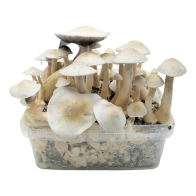
- Cap: 50–150 mm diameter. Convex to broadly convex to flat. Colour ranges from pure white to pale cream, with occasional faint golden or yellow tinting at the centre of mature caps
- Stem: Short and thick — noticeably stubbier than most cubensis strains. Bright white. Bruises an intense, vivid blue on handling, one of the strongest bruising reactions in the cubensis world
- Spores: Purple-brown in mass (standard cubensis). Subellipsoid with visible germ pore under 400–1000× magnification
- Spore production: Moderate. Deposits are lighter in colour than standard cubensis and can be uneven — spore swabs are the most reliable collection method for this line
Under the microscope, Yeti spores follow standard cubensis morphology — ellipsoid, smooth-walled, with a clear germ pore. What makes Yeti interesting for comparative microscopy is positioning it alongside its parent line TAT, where the spores are genuinely transparent, and a standard Golden Teacher, where the spores are dark and dense. The three together give you a clear visual progression of what albino genetics do at the spore level across different stages of expression.
What Makes Yeti Different from Other TAT Isolates
Within the TAT family — which includes lines like Ghost, Jack Frost, and Albino Riptide — Yeti is the one people consistently describe as the most morphologically extreme. The stubby, thick-stemmed fruit structure is the giveaway: where TAT and Ghost produce more slender, standard-proportioned mushrooms, Yeti fruits look like someone compressed everything vertically and widened the cap. That dense, compact growth pattern is the result of deliberate phenotype selection within the TAT Syndicate project.
Colonisation is slower than most cubensis strains, but the mycelium that develops is notably dense and rhizomorphic. Many cultivators who work across the TAT family treat Yeti as the "slow but rewarding" isolate in the group — patience on the front end, generous yields on the back end.
What's in the Pack
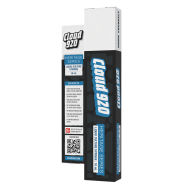
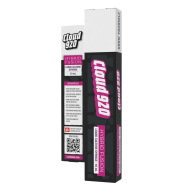
- 2× sterile cotton spore swabs, individually sealed
- Each swab is pre-loaded with Psilocybe cubensis Yeti spores collected directly from gill tissue
- Ready to use — no syringe, no liquid, no preparation needed
Spore swabs contain no psilocybin or psilocin and are sold exclusively for microscopy and taxonomic research purposes.
How to Use This Spore Swab
Work in a still-air box or under a laminar flow hood. Open the sealed wrapper, hold the swab by the handle, and keep your fingers off the cotton tip. Streak the tip across a prepared agar plate in a zigzag pattern, or roll a small amount of spore material onto a microscope slide with a drop of sterile water. Seal your plate immediately with Parafilm, label with strain and date, and incubate at 21–23 °C.
Expect germination within 5–14 days. Given Yeti's slower colonisation pace, do not rush the first transfer — wait for clearly rhizomorphic growth before moving to a second plate or grain.
New to spore swabs? Read our full step-by-step spore swab guide →
Recommended Supplies
- Petri dishes — for agar plating and isolate selection
- Agar Agar + Light Malt Extract (LME) — MEA gives good contrast for tracking dense white mycelium
- Parafilm — to seal plates directly after inoculation
- A still-air box or laminar flow hood — recommended for all albino-lineage work
Cultivation Notes
- Difficulty: Moderate — inherits Golden Teacher's forgiving side, but slower pace requires patience
- Substrate: BRF / PF Tek, rye grain, pasteurised dung, CVG mix
- Colonisation speed: Slow to moderate — noticeably slower than standard cubes; plan for 35–45 days to first harvest
- Fruiting temperature: 22–27 °C
- Yield: High — large, dense fruits; typically 3+ flushes when conditions are consistent
- Note: The intense blue bruising is normal and expected — it is not a sign of damage or contamination
Always start on agar first with Yeti. The slower colonisation pace makes contamination pressure higher on grain, so clean isolation from agar before moving to spawn gives you a significantly better success rate. Once you have established a
Additional Info
Additional Info
| Productcode | MCS.SPSWA.C920-YETI |
|---|---|
| Weight (KG) | 0.0050 |
| Form | Swab |
| Contents (ml) | No |
| Mushroom Strain | Yeti |
| Species | Psilocybe cubensis |
| Potency | Very High |
| Difficulty | Difficult |
| Origin | No |
You may also be interested in the following products: