
You have no items in your shopping cart.

Psychedelic Art: Stephen D. Ferris — Artist of the Month November (2026 Update)
Posted under: Psychedelic Culture
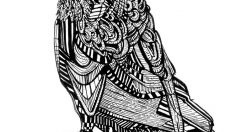
Artist of the Month — November | Meet Stephen D. Ferris, the self-taught Canadian artist whose geometric psychedelic art pushes consciousness to its edges. (2026 Update)
In this profile: Stephen D. Ferris creates intensely geometric, optical psychedelic art that seems to shift and breathe as you look at it. He is entirely self-taught.
We explore his unusual creative process, his isolated beginnings in Northern British Columbia, and why he titles almost all his work "Untitled."
There is something distinctive about how Stephen D. Ferris approaches a blank canvas. He does not plan. He does not sketch. He simply starts — and keeps going until the work is done.
"I draw intuitively," he says. "I tie ideas together until it looks good and I get lost in the process."
The results speak for themselves. Ferris creates psychedelic art that feels simultaneously structured and spontaneous. Geometric patterns of dots and triangles shift off their own axes. Optical designs push depth into unexpected places. Colour arrangements feel both carefully considered and entirely free.
Who Is Stephen D. Ferris?
Stephen D. Ferris grew up in a remote area of Northern British Columbia, Canada. By his own admission, he was a mediocre art student — "bad at traditional art skills," as he puts it. He did not discover his real creative voice until age 27, entirely by accident.
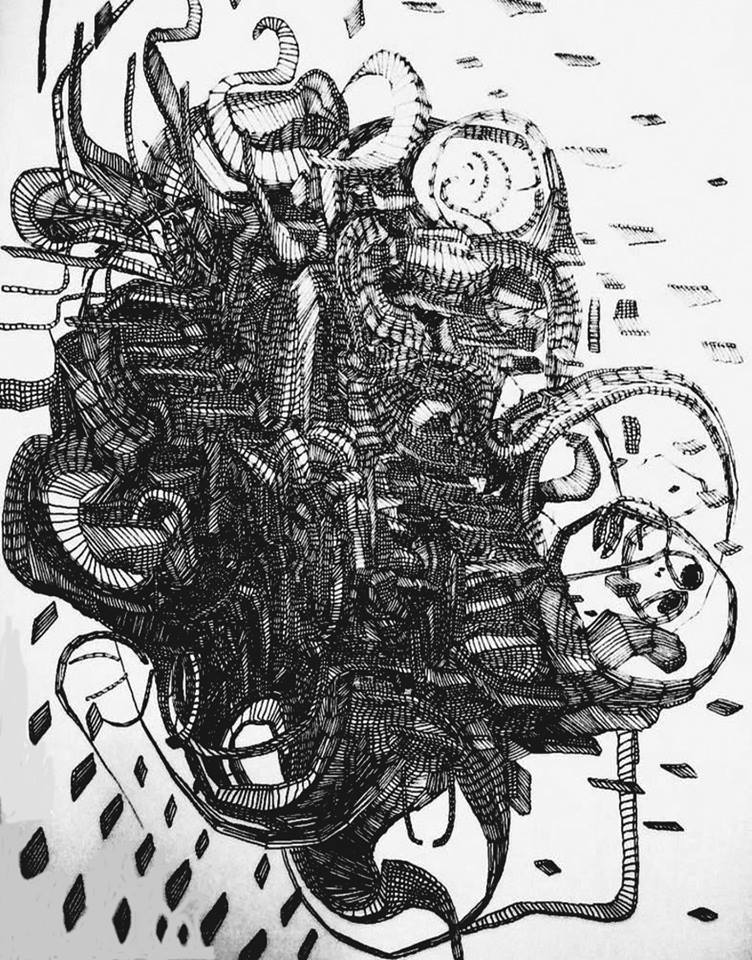
He picked up a pen and started drawing repetitive black-and-white patterns. What began as idle experimentation became an obsession, then a vocation, then a full-time career. Today, Stephen D. Ferris has published an artbook, staged solo shows at Harcourt House in Edmonton and the Art Gallery of Grande Prairie, and built a following of over 32,000 fans on Facebook alone.
His path was far from straightforward. For four years, he worked in Fort St. John — a small town in Northern BC and an unlikely home for psychedelic art. He describes the period as isolating: "I feared my artwork would end up in the garbage dump." His style did not fit the traditional local scene at all.
However, he turned to the internet and promoted his work online with massive success. When the Fort St. John art gallery hired new management, they scooped him for his first major solo show immediately. Other regional shows followed quickly. That momentum eventually led him to Edmonton, Alberta, and later to Calgary, where he participated in the BUMP Festival — one of Western Canada's largest public art events.
For a broader look at the psychedelic art tradition, read our post on shamanism and magic mushrooms. Visionary art and plant medicine share deep roots across centuries.
Psychedelic Art at the Edge of Perception
Ferris describes his own style as geometric, psychedelic, intuitive, abstract, optical, graphic, and minimal. Each word earns its place when you look at his pieces.
The work is highly optical — patterns seem to move, vibrate, and suggest depth that a flat surface should not allow. His circle drawings hit what he calls "the party note": a quality of visual energy that feels celebratory and destabilising at the same time.
The connection to psychedelic states is deliberate. His geometric language — concentric rings, tessellating triangles, flowing dot patterns — closely mirrors the visuals people report during experiences with magic mushrooms, ayahuasca, and other psychoactive substances. Whether or not any specific experience produced any specific image, the resonance is real and consistent.
For a broader sense of how psychedelics and visual art intersect, take a look at our profiles of Android Jones, Randal Roberts, and the visionary work of Pablo Amaringo.
Black and White First, Colour Later
Ferris started exclusively in black and white — pen and ink, with no colour at all. He mastered his optical design language in monochrome before introducing colour. He did this by adding paint pens directly to existing black-and-white pieces.
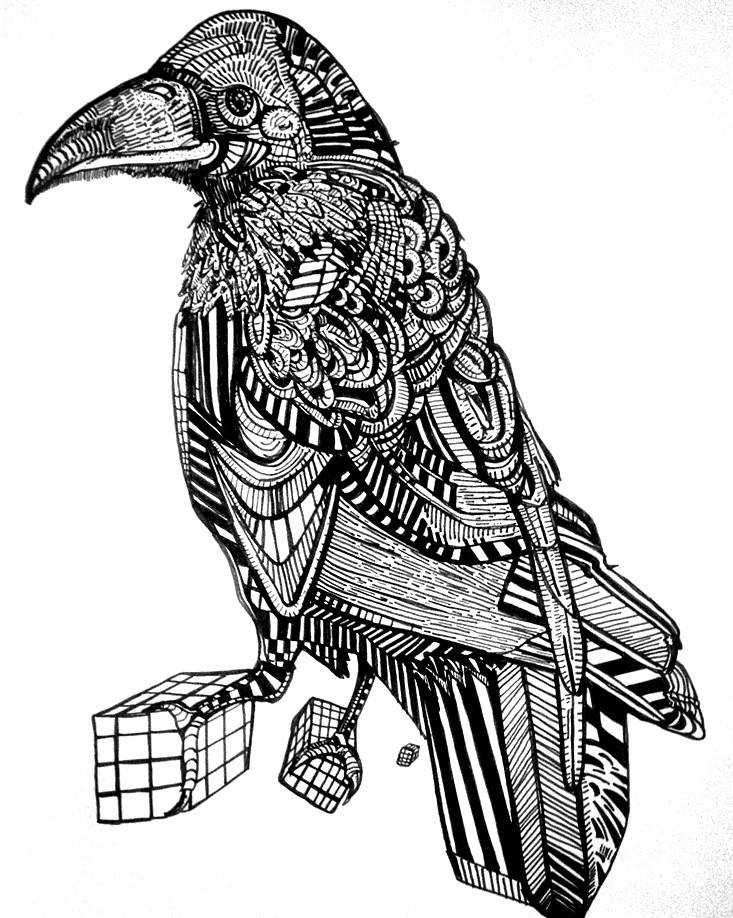
Today, most of his psychedelic art uses colour. Still, he admits he personally prefers black and white. There is something about the starkness — the way patterns have nowhere to hide — that he finds compelling. The discipline of monochrome forced him to rely entirely on form, proportion, and optical effect.
His published artbook, BLACK AND WHITE, compiles the best of this early phase. Much of the original work has since been lost, sold, or destroyed. As a result, the book stands as a valuable document of the period when his visual language first took shape.
Art tip: Ferris' method of starting in black and white before adding colour mirrors a common creative principle. Strip away decoration first and get the structure right. Many artists who explore microdosing describe a similar clarity — seeing the essential form before filling in the details.
Music as a Creative Guide
One of the most interesting aspects of Stephen D. Ferris' process is the role of music. He works exclusively to music, and it actively shapes the rhythm and mood of what he creates.

His preferences run toward minimal and electronic genres: tech house, minimal techno, downtempo, IDM, minimal drum and bass, and garage. He gravitates to darker, moodier styles — music with clever sounds, slick repetition, and a strong sense of internal rhythm. "The music guides the pace and mood," he says.
This parallel between music and psychedelic art is fascinating. In altered states, music does not sit in the background. Instead, it actively co-creates the experience. You can read more about that relationship in our guide to picking the perfect psychedelic playlist.
Why "Untitled"?
Perhaps the most provocative decision Ferris makes is to call most of his psychedelic art "Untitled." He explains why clearly: he does not want to hint at his own interpretation. Instead, he wants the viewer to bring their own meaning.
"People point out awesome stuff I don't see all the time," he says. "I prefer it that way."
This is a principled choice. The patterns he creates are not symbols with fixed meanings — they function as triggers and invitations. What they mean depends entirely on who looks and what they bring to the encounter. In this way, Ferris places his work in a long tradition of abstract and psychedelic art that refuses to be closed down by language. The painting does not tell you what to see. It creates the conditions for seeing.
This openness connects to a broader idea within psychedelic culture: set and setting shape every experience. The same principle applies to viewing psychedelic art. For more on set and setting, read our article on mushrooms and the mind.
Animals, Plants, and New Directions
Alongside his purely geometric work, Ferris also applies his visual style to animals and plants. Birds, dandelions, and other natural forms appear rendered in his distinctive optical-geometric language. These pieces show how his style translates to recognisable subjects without losing its essential character.
In 2025, his mural The Illustrated Man went on display at the Art Gallery of Grande Prairie — a large-scale outdoor work that brought his psychedelic art to a new audience. He continues to expand into animals, nature, and collaborative projects.
Where to Find Stephen D. Ferris
Explore the full portfolio at stephen-ferris.com. Additionally, his work appears on Artsy, where you can browse available prints and originals. Follow him on Instagram (@stephendferris), Facebook, and Reddit (u/StephenFerris) for new work and process videos.
For more profiles of the artists and thinkers who shaped psychedelic culture, see our features on Terence McKenna, María Sabina, and Muertify. Also explore magic truffles if you want to understand the experience behind the art.
Inspired by psychedelic art and culture? Explore our range of magic truffles and learn about microdosing for creative flow.
Note: If you experience mental health challenges and feel curious about psilocybin or other psychedelic therapy, please consult a medical professional first. Do not self-prescribe. The right support and guidance matter when exploring psychedelics.


March 23, 2026