
You have no items in your shopping cart.

Psychedelic Art: Jay Jagannath — Artist of the Month September (2026 Update)
Posted under: Psychedelic Culture
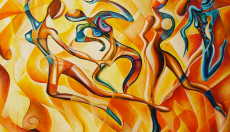
Artist of the Month — September | Meet Jay Jagannath, the Chilean visionary artist painting the astral world. (2026 Update)
In this profile: Jay Jagannath is a psychedelic artist from Chile whose paintings are windows into an inner world shaped by bhakti yoga, vegetarianism, and a deep sense of spiritual purpose.
We sat down with Jaga to talk about his art, his philosophy, and what psychedelics mean to him.
There are artists who paint what they see, and artists who paint what they feel. Jay Jagannath — known simply as Jaga — paints what he remembers. Not memories from this lifetime, but soul flashes: glimpses of far worlds, echoes of past lives, visions of the universe as he experiences it from the inside.
Born and based in Chile, Jaga creates psychedelic art that pulses with life — floating dancers reaching toward the sun, guitarists and flutists suspended in geometric skies, golden goddesses surveying red deserts. His work belongs to the tradition of visionary art: images that aim not just to decorate a wall, but to transport the viewer to another state of consciousness.
Who Is Jay Jagannath?
Jay Jagannath spent much of his childhood in monasteries, singing mantras and practising bhakti yoga — one of the oldest spiritual philosophies in the world, centred on devotion, love, and the recognition that all living things share a common origin. This early formation shaped everything: his view of art, of consciousness, of the role he believes he is here to play.
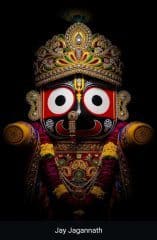 Jay Jagannath
"My duty," he says, "is to heal myself and the planet, using my imagination to serve spiritual consciousness."
He is a committed vegetarian, and he speaks about this not as a dietary choice but as a spiritual one. "You can't talk about love with blood in your stomach," he says. "Embracing vegetarianism increases sensitivity, true perception, and high consciousness. It means respecting nature."
This integration of ethics and artistry gives his work a coherence that goes beyond visual style. Every painting is also a statement about how he believes life should be lived.
The Paintings: Mirrors of the Astral World
Jaga describes his paintings as mirrors reflecting the astral world — the inner dimension of reality that exists beyond ordinary sensory perception. In his view, the astral world is not imaginary. It is as real as the physical world; it simply requires different faculties to perceive.
"Everything I create," he says, "already exists in many universes. I am not inventing it. I am remembering it."
His work features recurring motifs: multi-eyed beings that observe without judgement, human figures floating above mushrooms, geometric patterns that echo the structure of consciousness, rich colour fields that feel both ancient and alive. One painting in particular captures something central to his philosophy — a man floating above mushrooms, reaching toward a strange being with many eyes. For Jaga, this image represents the experience of being constantly observed by the universe, and the courage to receive cosmic blessings openly.
The influence of psychedelic perception is evident throughout his work, but Jaga is careful to distinguish between chemical means and other paths to the same states. He has reached high states of consciousness through bhakti yoga alone — through devotion, renunciation, and what he calls "the attitude of becoming a channel for mystic universal wisdom."
Psychedelics as a Gift
When we asked Jaga about psychedelic substances, his answer was thoughtful and non-dogmatic. He sees them as a gift — a tool for awakening that can help people glimpse the personality of the world and the soul beneath appearances. However, he is clear that they are not to be abused.
"Psychedelics cure ignorance," he says. "They allow you to learn, to realise, to perceive differently. But the same states can be reached through attitude — through renouncing self-benefit and dedicating yourself to others."
This perspective places him in an interesting position within psychedelic culture. He neither dismisses substances nor relies on them. For him, the psychedelic state is not the destination — it is a window. The work of actually changing and growing as a person requires something more sustained: a daily practice of gratitude, humility, and service.
For more on the relationship between psychedelics and consciousness, see our article on mushrooms and the mind.
Advice for Anyone Who Wants to Enter His Worlds
We asked Jaga what advice he would give to someone who wants to understand his art more deeply — or to access the states of consciousness it depicts. His answer was practical and grounded:
These are not the instructions of a passive dreamer. They are the commitments of someone who takes the inner life seriously and believes that art, ethics, and consciousness are inseparable.
Why Psychedelic Art Matters
Psychedelic art — the broader tradition to which Jaga belongs — has always done something that mainstream art often avoids: it takes the invisible seriously. It attempts to render what happens inside the mind when consciousness expands, whether through substances, meditation, near-death experiences, or spiritual practice.
In doing so, it creates a shared visual vocabulary for experiences that are otherwise deeply private and difficult to communicate. When someone looks at a piece of psychedelic art and feels recognised — when they think, "yes, that is what it was like" — something important happens. The isolation of the inner life is reduced. The experience becomes part of a shared culture.
Jaga's work does this with unusual warmth. His paintings are not aggressive or disturbing. They are invitations — to look more carefully, to question what is real, to consider that the winding dancers and the floating beings might not be fantasies at all, but memories of somewhere you have always, in some sense, already been.
Explore more visionary artists in our coverage of psychedelic artists like Android Jones and the ayahuasca art of Pablo Amaringo.
Inspired to explore your own inner worlds? Discover our range of magic truffles and microdosing products.


March 23, 2026