You have no items in your shopping cart.
Psilocybin and Psilocin: How Magic Mushrooms Work
Posted under: Psilocybin Science & News
The Science Behind the Magic — Psilocybin and Psilocin Explained
Magic mushrooms make you see the world differently. But what, exactly, causes that? The two main active compounds in magic mushrooms are psilocybin and psilocin — a pair of naturally occurring tryptamines that interact with your brain in a surprisingly elegant way.
In this guide, we break down what these substances are, how your body processes them, what they do in the brain, and what the latest science says about their safety.
Psilocybin and psilocin are the reason magic mushrooms are, well, magic. These two tryptamine alkaloids work together — one acts as the carrier, the other as the key. Understanding how they work not only satisfies curiosity, it also helps you approach the experience with more clarity and confidence. Because in this world, understanding comes before experience.
The Blue Bruise: Your First Visual Contact with Psilocybin
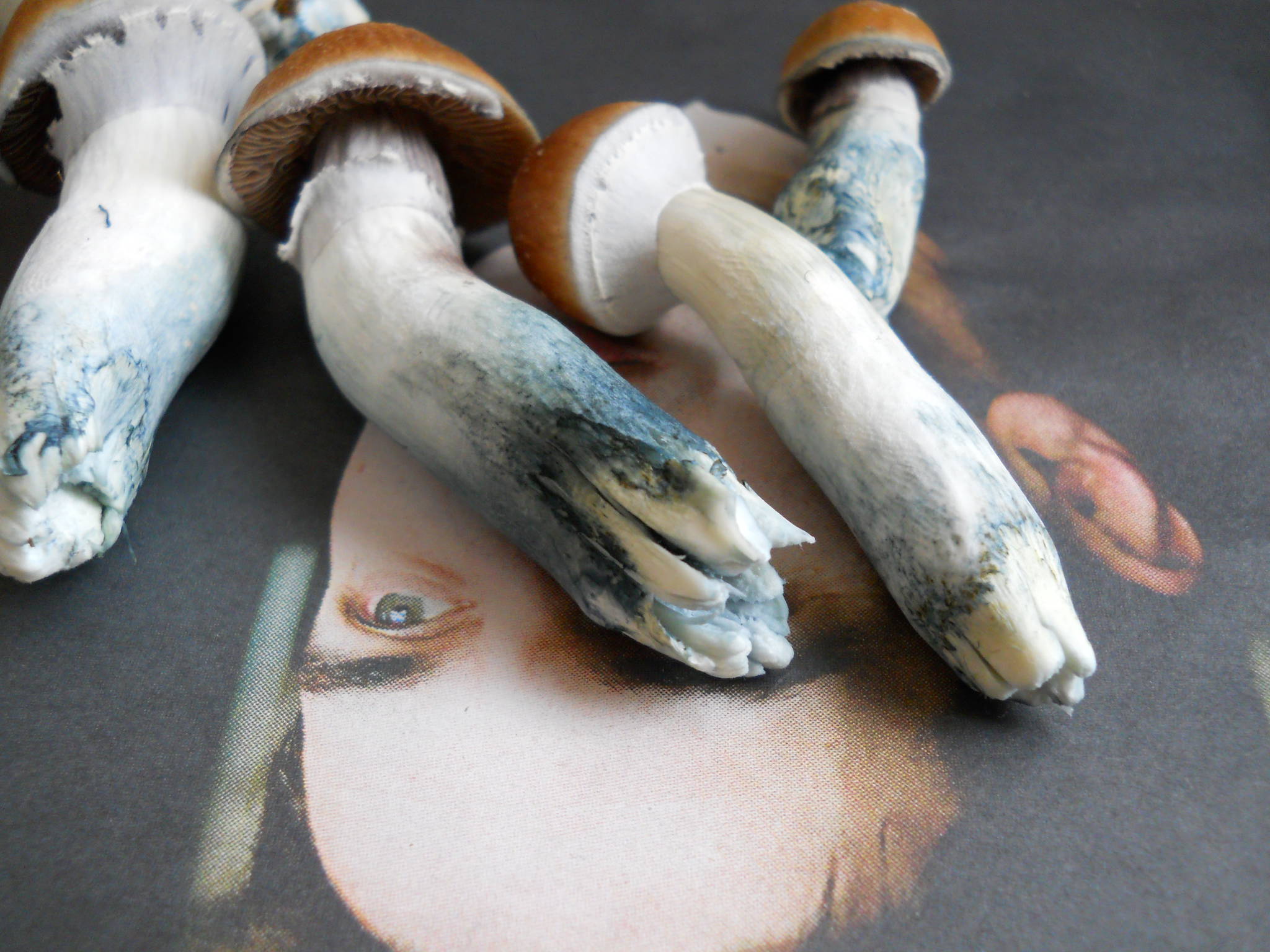
Have you ever picked a mushroom from your grow kit and noticed the stem turning blue at the point where you touched it? That colour change is not a coincidence. It is, in fact, your first visual contact with psilocybin and psilocin at work.
When you damage the mushroom tissue, the compounds inside oxidise on contact with air. This reaction — called bruising — produces a blue-green pigment. Moreover, research suggests the degree of bluing roughly correlates with the concentration of psilocin in the mushroom. In other words, a deeper blue often signals higher potency. It is also one of the key identifying features mycologists use to distinguish psilocybin-containing species in the wild.
Blue bruising alone is not a guarantee that a mushroom is safe or correctly identified. Always use it alongside other identification features — spore print colour, gill structure, and habitat. When in doubt, consult an expert.
What Are Psilocybin and Psilocin?
Both compounds belong to the tryptamine family — the same broad chemical family as serotonin, melatonin, and DMT. They occur naturally in over 200 mushroom species worldwide, most of them in the genus Psilocybe. In addition to psilocybin and psilocin, mushrooms also contain two related tryptamines: baeocystin and norbaeocystin, which likely contribute to the overall effect.
Psilocybin goes by several other names in scientific literature:
Psilocin is also known as:
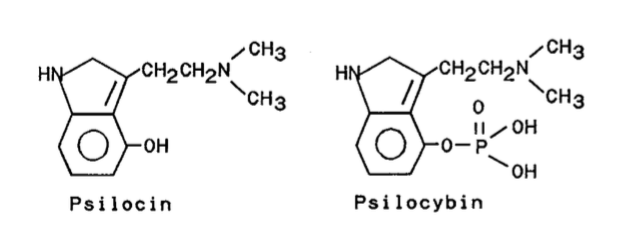
The Chemistry
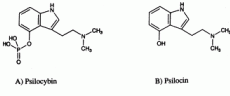
Psilocybin's chemical name is 4-phosphoryloxy-N,N-dimethyltryptamine. Its molecular formula is C₁₂H₁₇N₂O₄P. Psilocin's chemical name is 4-hydroxy-N,N-dimethyltryptamine (4-OH-DMT), with molecular formula C₁₂H₁₆N₂O. The key structural difference is simple: psilocybin has a phosphate group attached at the oxygen atom. Psilocin does not. That one difference is the reason psilocybin is essentially a prodrug — a dormant form that your body converts into the active compound.
| Psilocybin | 4-phosphoryloxy-N,N-dimethyltryptamine · C₁₂H₁₇N₂O₄P · prodrug (inactive) |
| Psilocin | 4-hydroxy-N,N-dimethyltryptamine · C₁₂H₁₆N₂O · active compound |
| Also present | Baeocystin, norbaeocystin |
| Chemical family | Tryptamines (same family as serotonin) |
How Your Body Converts Psilocybin into Psilocin
When you eat a magic mushroom, your body starts working immediately. Enzymes in the liver and gut — specifically alkaline phosphatases — strip the phosphate group from psilocybin. As a result, it becomes psilocin. This conversion happens quickly, typically within 20–40 minutes of ingestion. From that point on, psilocin is the substance doing the work.
Psilocin then enters the bloodstream and crosses the blood-brain barrier. It reaches peak activity roughly 2–3 hours after you take it, and the body clears it within approximately 6 hours. Because of this relatively short metabolic window, the experience has a predictable and manageable duration — which is one of the reasons researchers value it in clinical settings.
What Psilocybin and Psilocin Do in the Brain
Here is where it gets genuinely fascinating. Psilocin closely resembles serotonin in molecular structure. Because of this similarity, it binds to serotonin receptors in the brain — particularly the 5-HT₂A receptor, which researchers now consider the primary driver of psilocybin's psychedelic effects. This is supported by decades of research and confirmed by the fact that 5-HT₂A receptor blockers like ketanserin reliably prevent the psychedelic experience.
When psilocin activates the 5-HT₂A receptor — especially in pyramidal neurons of the frontal cortex — it triggers a cascade of effects:
In simpler terms: psilocin essentially loosens the brain's usual filters. The thalamus — your brain's sensory gatekeeper — passes more information than usual to the cortex. Moreover, the inner critic goes quiet. The result is a state of heightened perception, emotional openness, and unusual connections between ideas and sensory experiences.
Research from 2025 showed that psilocin also changes the activity of genes involved in neuroplasticity — the brain's ability to rewire itself. In the words of study leader Prof. Philipp Koch: "Put simply, psilocin makes the brain more malleable again." This finding helps explain the positive effects observed in clinical studies on depression, PTSD, and addiction.
What Does the Experience Actually Feel Like?
The effects vary widely based on dose, mindset, and environment — what experienced psychonauts call set and setting. Generally, however, the experience moves through recognisable phases:
For a more detailed breakdown of intensity at each stage, see our 5 trip levels guide. For guidance on how much to take, our magic mushroom dosage guide covers everything from microdoses to high-dose experiences.
Are Psilocybin and Psilocin Harmful?
This is the most important question — and the evidence is reassuring, though not without nuance. Decades of research consistently rate psilocybin among the substances with the lowest harm profile. There is no evidence of physical addiction, no known lethal dose in humans, and no scientific proof of lasting brain damage from normal use.
A 2026 global safety analysis found only 56 psilocybin-related adverse event reports — compared to 1,573 for MDMA and 394 for LSD — despite psilocybin being the most commonly used classic psychedelic in population surveys. Furthermore, serious physical complications were rare. The most common adverse effect in clinical trials is temporary nausea.
However, psilocybin is not risk-free for everyone. Specifically, people with a personal or family history of psychosis or schizophrenia should avoid it entirely. In addition, combining it with other substances — especially lithium or MAOIs — carries serious risks. The substance amplifies your current emotional state, which means going in unprepared or in the wrong environment can lead to a difficult experience.
⚠️ A challenging trip is not the same as a harmful one — but it can feel overwhelming in the moment. The most effective protection is preparation: the right dose, the right mindset, and the right environment. Read our responsible use guide before you begin.
Psilocybin, Psilocin, and the Future of Mental Health
What started as a banker's curiosity in the mountains of Mexico has become one of the most researched areas in modern psychiatry. Clinical trials at Johns Hopkins, NYU, Imperial College London, and dozens of other institutions have demonstrated that psilocybin — used in a controlled therapeutic setting — produces significant reductions in depression, anxiety, PTSD, and addiction. A 2025 meta-analysis found that a 25 mg dose produced the strongest antidepressant effect in trials for major depressive disorder.
The mechanism behind these results connects directly back to what we described above. By temporarily disrupting the default mode network and increasing neuroplasticity, psilocybin gives the brain a window to form new patterns — to break out of the rigid loops of thought that characterise depression and anxiety. In other words, it does not sedate the problem. Instead, it opens a door.
For more on why so many people are now turning to psilocybin with intention and care, read our post on ten reasons why people take magic mushrooms. And if you are curious about lower-dose approaches, our guide to microdosing is a good place to start.
Ready to explore responsibly? Browse our magic mushroom grow kits — and always start with our responsible use guide.


March 23, 2026