
You have no items in your shopping cart.

Magic Mushrooms India Legal: Kerala Court Rules They're Not a Narcotic
Posted under: Psilocybin Science & News
Psilocybin Science News · 23 April 2026
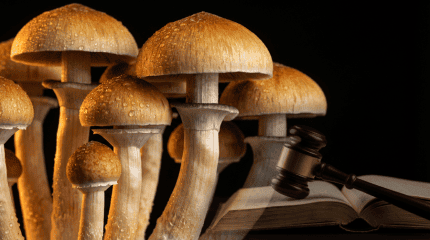
In January 2025, a landmark ruling made magic mushrooms India legal news worldwide. The Kerala High Court decided that psilocybin-containing fungi are not a scheduled narcotic or psychotropic substance under India's strict drug law. As a result, the judgment created a legal grey area affecting 1.4 billion people — and opened the door to future psilocybin research in one of the world's most populous countries.
India is home to 1.4 billion people and a centuries-old tradition of sacred plant use. Furthermore, it operates one of the world's most powerful pharmacy industries. Yet when it comes to magic mushrooms and psilocybin, the country's legal landscape just shifted. A single bail ruling from a judge in Kerala — a lush, rainy state on India's southwestern tip — is now cited in courtrooms across the subcontinent. It also appears in a peer-reviewed paper in a Sage journal. This is what happened, what the judgment actually says, and why it matters for the global psychedelic renaissance.
The Case That Made Magic Mushrooms India Legal News
On 4 October 2024, excise officials in Mananthavady, Wayanad district, stopped Rahul Rai. They found him carrying 6.59 grams of charas, 13.2 grams of ganja, 226 grams of psilocybin-containing magic mushrooms, and 50 grams of mushroom capsules. He was charged under Sections 22(c) and 8(c) of the Narcotic Drugs and Psychotropic Substances Act, 1985 (NDPS Act). The prosecution argued that 276 grams of mushrooms exceeded the 50-gram commercial quantity threshold for psilocybin. Consequently, he was held in non-bailable custody.
After roughly 90 days in detention, his defense team — led by advocates Nirmal S. and Veena Hari — filed a bail application before Justice P.V. Kunhikrishnan of the Kerala High Court. The legal question was deceptively narrow. Was the total weight of the mushrooms the relevant figure, or only the actual psilocybin content within them? The answer would determine whether the magic mushrooms India legal definitions placed fungi in the same category as pure synthetic narcotics.
The Judgment: Fungi Are Not a Mixture
Justice Kunhikrishnan's reasoning turned on a technical point in the NDPS Act. Note 4 of the Table states that when a narcotic drug appears in a "mixture" with other substances, the total weight determines quantity classification. The prosecution argued accordingly that magic mushrooms were a mixture of psilocybin and neutral biological material. However, the court rejected this interpretation entirely.
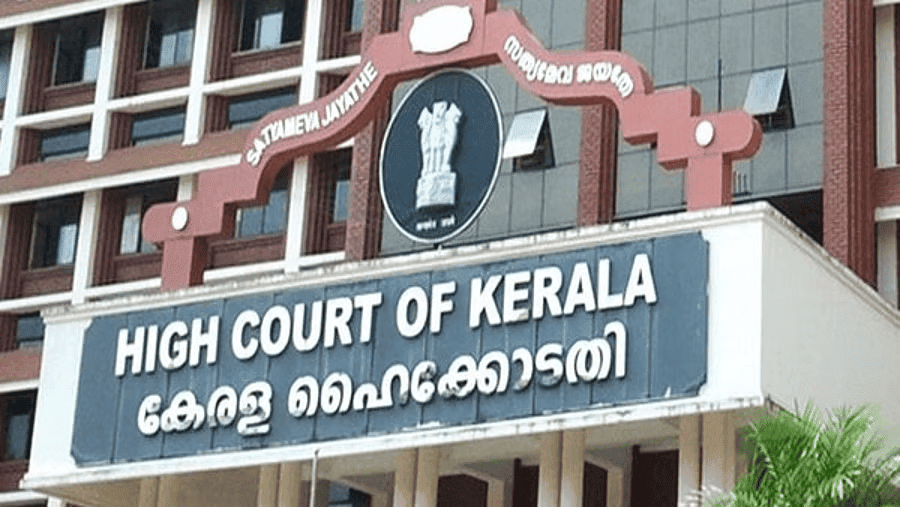
Citing earlier rulings from the Karnataka High Court (2013) and the Madras High Court (2024), Justice Kunhikrishnan held that a mushroom is a living organism — not a mixture. Note 4 therefore does not apply. In addition, the chemical analysis report submitted by the prosecution failed to specify the actual psilocybin weight present. Without that figure, there was simply no material evidence of a commercial quantity.
Key finding: "Mushroom or magic mushroom was not a scheduled narcotic or psychotropic substance. It was only a fungi." — Justice P.V. Kunhikrishnan, Kerala High Court, 13 January 2025 (Rahul Rai v. State of Kerala, 2025 SCC OnLine Ker 284)
The court cited a University of British Columbia article on therapeutic psilocybin dosing. Notably, that article confirms that dried Psilocybe cubensis contains roughly 1% psilocybin by weight. At that ratio, 276 grams of mushrooms yields approximately 2.76 grams of pure psilocybin. That figure sits just above the 2-gram small quantity threshold — and far below the 50-gram commercial threshold. Therefore, applying the principle that "bail is the rule, jail the exception," the court released Rahul Rai on a bond of ₹1,00,000.
What the Magic Mushrooms India Legal Ruling Does and Does Not Mean
Important: The judgment does not legalise magic mushrooms in India. Psilocybin remains a scheduled psychotropic substance under the NDPS Act. Possession, transport, and sale of psilocybin-containing fungi is still a criminal offence. What changed is how prosecutors must prove their case and how courts calculate quantity thresholds.
A 2026 peer-reviewed Sage journal paper titled India's Unique Legal Framework for Psilocybin Mushroom Research summarises the shift clearly. It states that the ruling "explicitly distinguished between mushrooms as biological organisms and their psychoactive compounds." As a result, only the actual psilocybin content by weight now determines regulatory status. In practice, this means prosecutors must commission detailed forensic reports — they can no longer simply weigh the mushrooms whole.
This distinction matters enormously on the ground. India has a well-documented history of psychedelic tourism in Goa, Kasol, the Parvati Valley, and parts of Rajasthan. In those regions, magic mushrooms grow semi-openly and enforcement has historically been inconsistent. Moreover, the Kerala ruling gives defense lawyers a powerful precedent to challenge non-bailable detention nationwide. The Karnataka and Madras High Courts had already established similar reasoning in 2013 and 2024. Consequently, the Kerala judgment now creates a three-court consensus that lower courts will find difficult to ignore.
Could India Become a Hub for Psilocybin Research?
This is where the magic mushrooms India legal shift becomes globally significant. The same Sage paper argues that India's framework creates "a distinctive regulatory pathway for psilocybin-containing mushrooms." Because the organism itself is not scheduled, research institutions could apply for licences under the Drugs and Cosmetics Act to study the whole mushroom. By contrast, navigating the far more restrictive NDPS Schedule for isolated psilocybin would be considerably harder. India also offers world-class pharmaceutical infrastructure, a large psychiatric patient population, and comparatively low clinical trial costs.
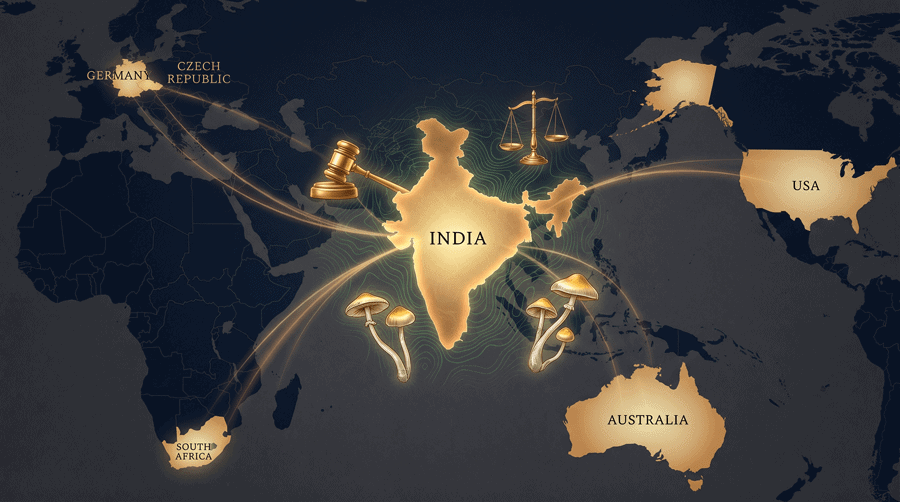
Defense advocate Veena Hari went further after the judgment. She argued that psilocybin-containing mushrooms "should be considered for medical use under the Drugs and Cosmetics Act." Such a move would parallel the trajectory of Germany and the Czech Republic. Both countries moved from court precedent to regulated compassionate-use programmes within just a few years. Germany became the first EU nation to permit prescription psilocybin for treatment-resistant depression in 2025. Similarly, the Czech Republic formalised its psilocybin therapy framework in January 2026.
However, the Indian government's official stance remains conservative. The Narcotics Control Bureau (NCB) has not commented on the ruling. Furthermore, there is no sign of a legislative push to amend the NDPS Act. Parliament could theoretically close the loophole by explicitly scheduling all psilocybin-containing fungi. As such, analysts describe the ruling as a crack in the dam — not a flood.
A Global Pattern: Courts Leading Lawmakers
The Kerala judgment reflects a broader international trend. Across the world, courts are reshaping the legal status of psilocybin faster than legislators can respond. In South Africa, for example, a 2024 High Court ruling declared parts of the Drugs Act unconstitutional as applied to therapeutic psilocybin use. In the United States, multiple state courts found that existing drug laws did not clearly cover naturally occurring mushrooms. Moreover, in April 2026, President Trump signed an executive order directing the FDA and DEA to fast-track psychedelic research.
What makes the magic mushrooms India legal situation particularly distinctive is scale. The WHO estimates that more than 150 million Indians need mental health care but cannot access it. Consequently, if psilocybin-assisted therapy were to become available in India — even at a limited clinical scale — the public health implications would dwarf anything seen in Western markets. The Kerala ruling is not the beginning of that story. Nevertheless, it may, in retrospect, be remembered as one of its earliest chapters.
The Science Behind the Ruling
What the court cited — almost in passing — is worth unpacking. The UBC article referenced by Justice Kunhikrishnan confirms what psilocybin science has established for decades. Dried Psilocybe cubensis typically contains 0.63–1% psilocybin and 0.35–0.6% psilocin by dry weight. Furthermore, those figures vary considerably between strains, growing conditions, and harvest timing. Treating the whole organism as equivalent to its active compound is therefore scientifically inaccurate. A court recognising this in 2025, in India, represents a small but meaningful alignment of law with biology.
Meanwhile, the global scientific consensus continues to accelerate. A landmark 2026 brain imaging study at McGill University — spanning 500 scans across five countries — found a shared neural signature across all classic psychedelics. This confirms that the therapeutic mechanism is real, reproducible, and not substance-specific. In addition, ongoing UCSF trials are testing psilocybin in Parkinson's disease, palliative care, and chronic pain. The science is outrunning the law in almost every country. In India, a single court in Kerala has taken one step toward closing that gap.
Curious about magic mushrooms and how they work? Read our complete guide: What Are Magic Mushrooms? Science, Species, and How They Work
Key Facts at a Glance
| Case name | Rahul Rai v. State of Kerala, 2025 SCC OnLine Ker 284 |
| Court | Kerala High Court, India |
| Judge | Justice P.V. Kunhikrishnan |
| Date decided | 13 January 2025 |
| Core finding | Magic mushrooms (fungi) are not a "mixture" under the NDPS Act — only actual psilocybin content by weight determines quantity classification |
| Outcome | Bail granted; accused released on ₹1,00,000 bond |
| Supporting precedents | Karnataka HC (2013), Madras HC (2024) |
| Does it legalise magic mushrooms? | No — psilocybin remains controlled; ruling affects evidentiary standards and bail eligibility only |


April 25, 2026