
Votre panier est vide.

Android Jones : artiste visionnaire du digital, performeur live et pionnier de la VR
Publié sous: Culture psychédélique
Portrait d'artiste psychédélique : Android Jones — visionnaire du numérique, performeur live et pionnier de la réalité virtuelle (mise à jour 2026)
Certains artistes travaillent avec de la peinture. D'autres avec du code, de la lumière et de l'espace. Android Jones travaille avec tout ça à la fois — et va encore plus loin, vers la réalité virtuelle, la performance live et cette frontière où la technologie rencontre la conscience. C'est l'une des figures les plus importantes de l'art visionnaire et psychédélique contemporain.
Portrait d'artiste : Android Jones est un artiste numérique installé dans le Colorado, connu pour ses performances live immersives, ses peintures digitales venues d'ailleurs et ses expériences de réalité virtuelle psychédélique pionnières.
Son travail se déploie sur les scènes de festivals, les murs de musées, des monuments emblématiques et en réalité virtuelle — il relie spiritualité, technologie et états modifiés de perception.
| Vrai nom | Andrew Jones |
| Lieu de résidence | Lyons, Colorado, États-Unis |
| Style | Electro-Mineralism — art visionnaire numérique |
| Œuvres clés | Samskara (expérience en dôme à 360°), Microdose VR (outil de flow créatif) |
| Parcours | Formé à la Ringling School of Art and Design ; a travaillé chez Industrial Light & Magic et Nintendo/Retro Studios |
| Apparitions notables | Smithsonian American Art Museum, Opéra de Sydney, Empire State Building |
De l'école d'art à Industrial Light & Magic
Andrew Jones a grandi à Lyons, dans le Colorado — une petite ville du comté de Boulder, où la culture artistique et le plein air sont très présents. Il a commencé à étudier l'art à huit ans. Plus tard, il a intégré la Ringling School of Art and Design à Sarasota, en Floride, où il s'est formé au dessin traditionnel, à la peinture et à l'animation. Cette solide base classique donne à son travail numérique une profondeur structurelle peu commune.
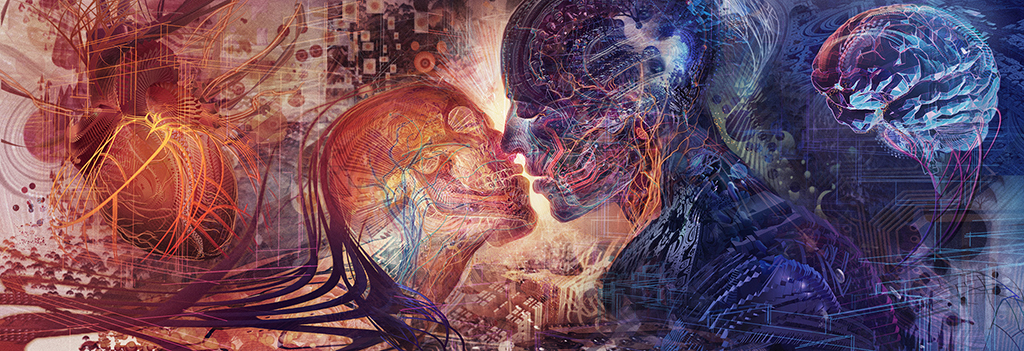
Son diplôme en poche, Jones décroche un stage chez Industrial Light & Magic, le studio d'effets visuels de George Lucas, l'un des plus prestigieux au monde. Il passe ensuite cinq ans chez Retro Studios, à Austin, au Texas, où il construit l'univers visuel de la franchise Metroid Prime pour Nintendo. Mais Jones avait des ambitions qui dépassaient le travail commercial.
En 2005, il quitte l'industrie du jeu vidéo pour travailler en indépendant. Suivent dix ans de voyages à l'international, de peinture live dans des festivals transformationnels, et la naissance d'une pratique qui échappe aux catégories artistiques habituelles.
Electro-Mineralism et circuit des festivals
Android Jones s'est fait connaître grâce à ses performances de peinture live hors du commun dans des festivals du monde entier. Lors d'événements comme Burning Man — auquel il a participé 18 années de suite — et le Boom Festival, il a créé en temps réel des œuvres numériques monumentales. Il peignait avec la lumière devant un public en direct. Ce mélange de maîtrise technique, d'intention spirituelle et de spontanéité brute, le public l'avait rarement vécu.
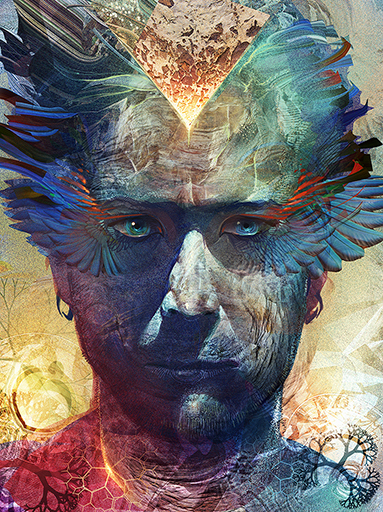
Jones décrit son style artistique comme de l'Electro-Mineralism. Ce terme reflète sa conviction que la technologie et le monde naturel se prolongent l'un l'autre au lieu de s'opposer. Selon le Smithsonian American Art Museum, Jones « cherche à saisir des concepts complexes et à modifier la perception du spectateur, en repoussant les limites de l'imagination grâce à des médias innovants ».
Ses peintures — superposées, lumineuses et d'une grande densité symbolique — puisent dans l'iconographie hindoue, la géométrie sacrée, la biologie et son expérience visionnaire personnelle. Les images paraissent à la fois anciennes et futuristes. Pour un regard plus large sur les liens entre psychédéliques et art à travers les cultures, lis notre article sur le chamanisme et les champignons magiques.
Psychédéliques et tradition visionnaire
Android Jones a parlé ouvertement de la façon dont l'expérience psychédélique a façonné son langage visuel. Il s'inscrit dans une tradition plus large d'artistes visionnaires dont l'œuvre reflète des états intérieurs atteints par la méditation, le rituel ou les plantes médicinales. Cette tradition compte notamment Robert Venosa, Alex Grey et Ernst Fuchs.
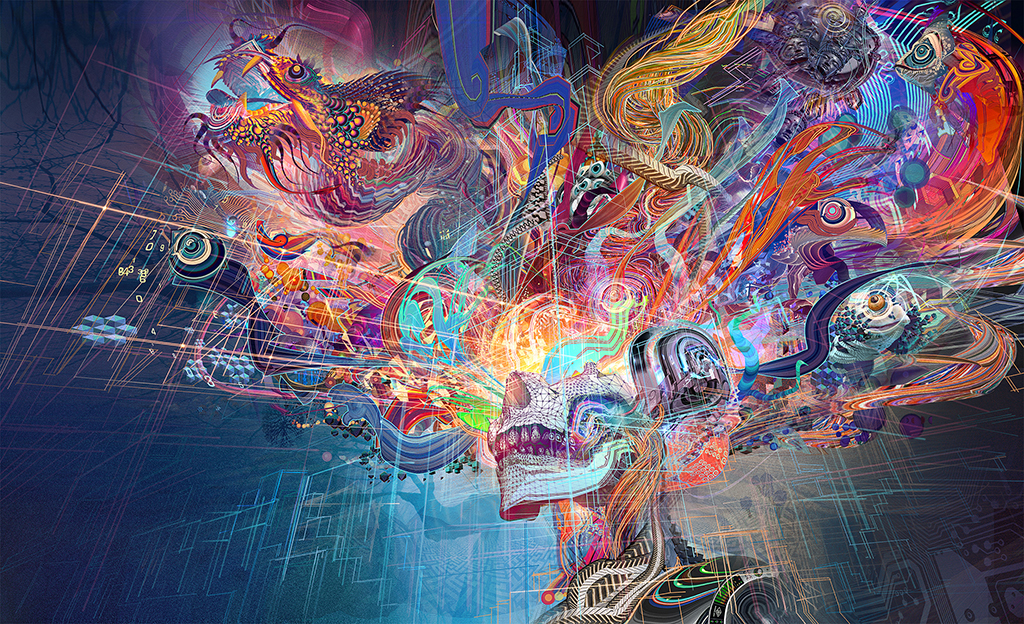
Jones a rencontré Robert Venosa lors d'un événement artistique à Boulder, alors qu'il n'avait que 16 ans. Il décrit cette rencontre comme fondatrice — un moment qui a confirmé la direction que prendrait son travail. Pour Jones, l'art psychédélique ne se limite pas à représenter des expériences sous drogue. Il donne accès à un mode de perception — une profondeur de conscience visuelle — que certaines expériences peuvent catalyser. L'œuvre devient alors elle-même un outil pour éveiller cette perception chez les autres.
Cette philosophie s'inscrit naturellement dans la culture psychédélique plus large qui entoure les festivals transformationnels. Elle explique aussi pourquoi le travail de Jones parle autant aux communautés qui s'intéressent aux champignons magiques, à la spiritualité et à l'exploration de la conscience. Notre article sur les champignons et l'esprit explore certaines de ces dimensions psychologiques plus en profondeur.
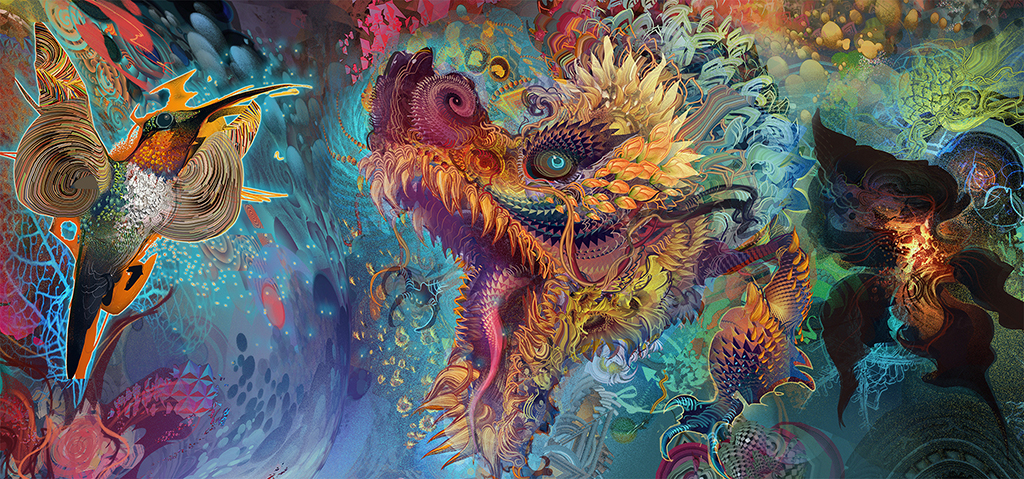
Samskara : quand l'art rencontre la réalité virtuelle
En 2015, Android Jones reçoit une invitation inhabituelle. Un personnage mystérieux, connu uniquement sous le nom de « The Swami » et installé à Chiang Mai, en Thaïlande, le contacte au sujet d'une expérience en dôme qu'il est en train de créer. Le projet devient Samskara — une expérience VR immersive à 360 degrés, inspirée des récits des Vedas hindous. On y retrouve des personnages mythologiques réinventés par Jones, dans un univers visuel entièrement animé.
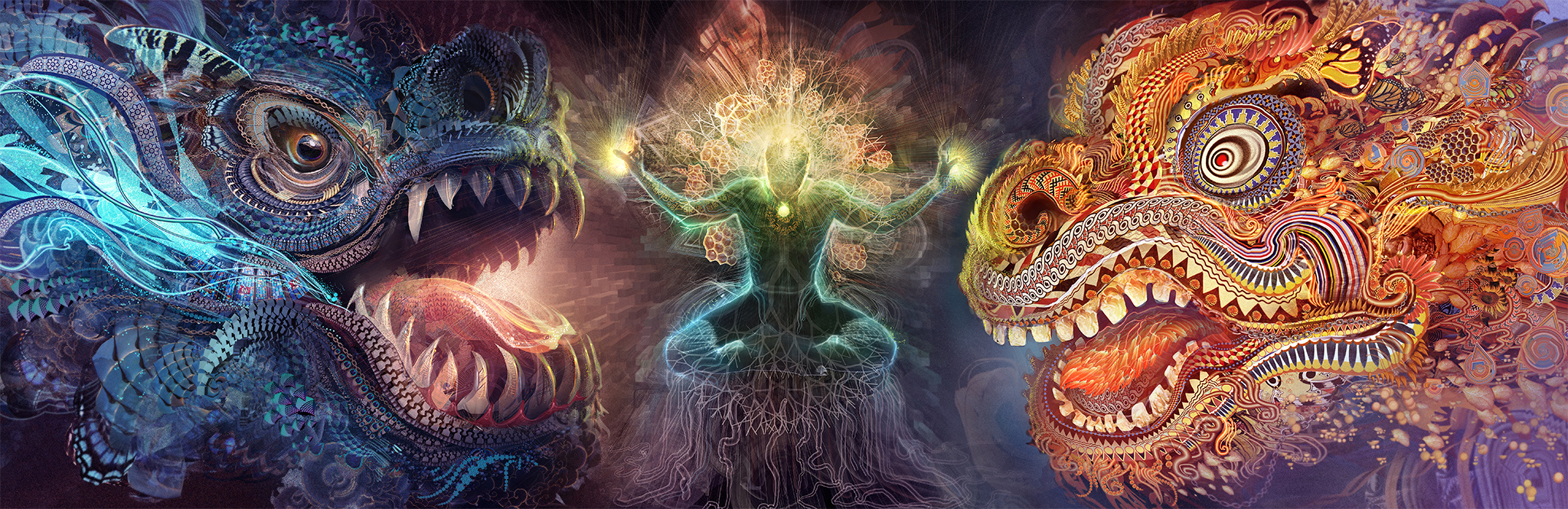
Samskara a été présenté en première au VRLA en 2016. Il a ensuite été projeté au Fisk Planetarium de Boulder, dans le Colorado, au Lost Lands Festival et dans d'autres lieux à travers le monde. L'expérience plonge les spectateurs dans un monde animé entièrement tiré de l'art de Jones. En pratique, elle fonctionne comme une méditation visuelle guidée — une version high-tech de ce que les cultures visionnaires cherchent à faire depuis des milliers d'années à travers l'art rituel.
Jones a décrit le visionnage de Samskara dans un casque VR comme « ce qui s'est le plus rapproché d'une expérience de réalité virtuelle capable de me mettre dans un état modifié de conscience — comme une drogue numérique ». Si tu es curieux des véritables états modifiés de conscience, notre guide complet des truffes magiques t'explique comment fonctionnent les truffes à psilocybine.
Microdose VR : peindre avec des particules
En 2016, Jones cofonde Vision Agency et lance Microdose VR — un outil créatif en VR conçu pour aider les utilisateurs à atteindre un état de flow créatif. L'idée est née directement de ses dix ans d'expérience de performances live. Il voulait démocratiser la sensation de peindre avec la lumière pour toute personne disposant d'un casque VR ou d'une manette de jeu.
Dans Microdose VR, on peint avec des émissions de particules plutôt qu'avec des lignes ou des coups de pinceau. Les particules se transforment, évoluent et disparaissent. Il n'y a ni fonction de sauvegarde, ni bouton « annuler ». L'important, c'est la présence et le flow, pas le résultat. Comme Jones le dit lui-même, l'objectif était de « donner naissance à un nouveau type d'artiste VR ».
Le nom « Microdose » n'a rien d'un hasard. Tout comme le microdosing de psychédéliques consiste à prendre des quantités infraliminaires pour accéder à une autre qualité de conscience, Microdose VR offre un petit aperçu accessible de l'état créatif modifié que Jones cultive depuis des années. Aujourd'hui, la version Omega de Microdose VR fonctionne avec n'importe quelle manette de jeu — pas besoin de casque VR.
Astuce créative : l'accent que Jones met sur le flow plutôt que sur le produit fini rejoint ce que décrivent beaucoup de personnes qui pratiquent le microdosing — la valeur se trouve dans le processus lui-même, pas dans le résultat. Pour en savoir plus sur les applications créatives, consulte notre guide du microdosing.
Installations publiques et rayonnement mondial
Le travail d'Android Jones a investi certains des monuments les plus reconnaissables au monde. Ses projections ont illuminé l'Opéra de Sydney et l'Empire State Building, offrant ses images foisonnantes à des millions de spectateurs. Il a également assuré les visuels live de la tournée Fare Thee Well du Grateful Dead en 2015 — l'un des événements les plus marquants de l'histoire de la musique live.
Ses œuvres font partie de la collection permanente de l'Oakland Museum of California. Le Smithsonian American Art Museum a inclus son travail dans l'exposition de référence « No Spectators: The Art of Burning Man ». Il a aussi exposé à la galerie d'art de l'Envision Festival 2024 au Costa Rica.
Pour découvrir d'autres portraits d'artistes à la croisée des psychédéliques et de la créativité, consulte nos articles sur Randal Roberts, Muertify et Stephen D. Ferris.
Où retrouver Android Jones
Découvre tout son portfolio et sa boutique sur androidjones.com. Suis-le sur Instagram (@android_jones) et Facebook pour ses nouvelles œuvres, les dates de ses shows en dôme et les mises à jour de Microdose VR. Essaie toi-même Microdose VR — il tourne sur Steam avec prise en charge de la manette.
Découvre aussi nos portraits des penseurs qui ont façonné la culture psychédélique : Terence McKenna, María Sabina et Pablo Amaringo.
Curieux de vivre l'expérience psychédélique qui inspire des artistes comme Android Jones ? Découvre nos
et nos
— des produits de qualité, expédiés depuis Amsterdam.
Remarque : si tu as des problèmes de santé mentale et que la psilocybine ou une autre thérapie psychédélique t'intrigue, parles-en d'abord à un professionnel de santé. Ne t'automédique pas. Un bon accompagnement et un bon cadre sont essentiels quand on explore les psychédéliques.


Mars 23, 2026