
Votre panier est vide.

Dépénalisation de la psilocybine en Oregon : une nouvelle étude JAMA révèle 90 000 consommateurs en plus
Publié sous: Science & Actus sur la Psilocybine
Publié le 18 mars 2026 · 6 min de lecture
Une étude majeure publiée dans JAMA le 10 mars 2026 apporte la première preuve causale que la décriminalisation de la psilocybine en Oregon a directement fait augmenter la consommation. Dans l'Oregon, premier État américain à avoir décriminalisé les champignons magiques, environ 90 000 personnes supplémentaires ont consommé de la psilocybine chaque année après la Measure 110. Les conclusions ont donc des implications majeures pour les politiques en matière de drogues dans le monde entier.
Décriminalisation de la psilocybine en Oregon : ce qui a changé et quand
En novembre 2020, les électeurs de l'Oregon ont adopté la Measure 110. Cette loi a décriminalisé la possession personnelle de toutes les substances contrôlées, y compris les champignons à psilocybine. L'Oregon est ainsi devenu le premier État américain à traiter la possession de drogues comme un enjeu de santé publique plutôt que comme une affaire pénale. Deux ans plus tard, en 2022, le Colorado lui a emboîté le pas avec son Natural Medicine Act. Cette loi a décriminalisé la psilocybine et d'autres psychédéliques naturels pour un usage personnel. Elle a en plus mis en place un cadre pour un accès thérapeutique supervisé.
Pendant des années, les chercheurs ont soupçonné que ces changements de politique alimentaient une hausse de la consommation. Mais il était difficile de distinguer l'effet de la loi de évolutions culturelles plus larges. Parmi elles : la fameuse renaissance psychédélique, l'attention croissante des médias et l'essor du discours sur la santé mentale. C'est précisément cette lacune que l'étude JAMA a voulu combler.
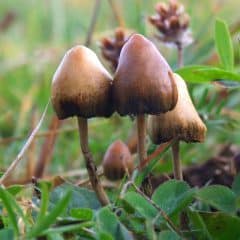 Champignons Psilocybe semilanceata sauvages dans la nature
L'étude JAMA : méthodologie et principaux résultats sur la décriminalisation de la psilocybine
L'étude a été menée par Joshua C. Black, PhD, et ses collègues de Rocky Mountain Poison & Drug Safety à Denver. Elle s'appuie concrètement sur 15 vagues de l'enquête nationale Survey of Non-Medical Use of Prescription Drugs. Au total, l'enquête a recueilli les réponses de 441 734 personnes entre 2018 et 2025. Les participants indiquaient s'ils avaient consommé de la psilocybine au cours des 12 derniers mois.
Plutôt que de simplement observer des tendances, l'équipe a utilisé une méthode de contrôle synthétique augmentée. En résumé, c'est une technique d'inférence causale qui construit un scénario statistique du type « et si… ». Elle prend comme point de comparaison les données des 48 autres États et de Washington D.C. De plus, le modèle a pris en compte des facteurs démographiques, socio-économiques et liés à la santé. Il a ainsi pu estimer à quoi aurait ressemblé la consommation de psilocybine en Oregon et au Colorado si la loi n'avait jamais changé.
| Résultat clé | Oregon | Colorado |
|---|---|---|
| Hausse de la consommation de psilocybine sur l'année écoulée | +2,1 points de pourcentage | +1,8 point de pourcentage (non significatif statistiquement) |
| Nombre estimé de consommateurs supplémentaires par an | ~70 000–90 000 personnes | ~85 000–110 000 personnes (indicatif uniquement) |
| Significativité statistique | Oui (IC à 95 % : 0,7–3,6) | Non — période d'observation après la loi plus courte |
| Consommation en centres agréés vs. hausse totale | La hausse totale dépasse la fréquentation des centres agréés | Non évalué |
Le résultat le plus frappant concerne le programme de psilocybine agréé de l'Oregon. La hausse estimée imputable à la décriminalisation de la psilocybine en Oregon dépasse le nombre de personnes qui fréquentent les centres officiels. L'Oregon compte désormais près de 30 établissements agréés, mais les séances coûtent entre 1 000 et 3 000 $. Les données suggèrent donc fortement que la plupart des nouveaux consommateurs l'ont fait en dehors d'un cadre clinique. Autrement dit : quand on décriminalise, la plupart des nouveaux consommateurs ne vont pas en clinique.
Que signifie cela pour les politiques en matière de drogues ?
Le chercheur principal, le Dr Joshua Black, a résumé l'enjeu en une phrase : « Cette étude répond à la question à laquelle les décideurs politiques sont réellement confrontés. Combien de personnes supplémentaires ont consommé une substance parce que la loi a changé ? » Répondre à cette question exige en effet une méthodologie d'inférence causale, et pas seulement un suivi des tendances. Cela fait de l'étude sur la décriminalisation de la psilocybine en Oregon un travail unique dans le domaine.
Ces résultats arrivent en outre à un moment charnière. L'Oregon a déjà en partie fait marche arrière sur la Measure 110 avec la House Bill 4002, signée en 2024. Ce texte a recriminalisé la possession personnelle de la plupart des substances contrôlées, psilocybine comprise, en réponse à la crise des opioïdes. Les chercheurs n'ont toutefois trouvé aucun lien causal entre la Measure 110 et les décès par overdose. Pendant ce temps, la thérapie supervisée à la psilocybine, encadrée par la Measure 109, reste légale. L'usage personnel hors cadre clinique est en revanche de nouveau un délit mineur (misdemeanour) dans l'État.
L'approche du Colorado, elle, associe la décriminalisation de l'usage personnel à un cadre d'usage supervisé et agréé. Il comprend la culture à domicile et le partage. Elle pourrait donc servir de modèle à d'autres États. L'étude JAMA n'a pas encore pu tirer de conclusions fermes pour le Colorado, car la période suivant l'entrée en vigueur de la loi était trop courte. Les données indicatives pointent malgré tout vers une tendance similaire.
Limites : Premièrement, l'étude repose sur des données d'enquête auto-déclarées, ce qui comporte un biais inhérent. Ensuite, les lois du Colorado diffèrent sensiblement de celles de l'Oregon, alors que les deux ont été analysées selon le même cadre. De plus, l'étude ne nous dit rien sur la qualité, le contexte ou les effets de la consommation supplémentaire qu'elle a détectée. Il est clair qu'un suivi plus long est nécessaire pour le Colorado.
La décriminalisation de la psilocybine en Oregon dans le contexte mondial
Les États-Unis n'agissent pas en vase clos. À l'échelle mondiale, la politique en matière de psilocybine évolue plus vite que jamais dans l'histoire moderne. L'Australie, par exemple, est devenue en 2023 le premier pays à autoriser la psilocybine comme médicament sur ordonnance. De même, la République tchèque est devenue début 2026 le premier pays de l'UE à autoriser la thérapie médicale à la psilocybine. Par ailleurs, l'essai PsyPal, financé par l'UE et dirigé par le Centre médical universitaire de Groningue, mène des essais cliniques à grande échelle à travers l'Europe.
Surtout, les conclusions de l'étude JAMA ajoutent une dimension essentielle à ce débat mondial. Les changements de politique n'influencent pas seulement qui peut accéder à la psilocybine à des fins thérapeutiques. Ils remodèlent en réalité les habitudes de consommation de toute la population. Comme le soulignent les auteurs, les régulateurs du monde entier devront peser les bénéfices potentiels au regard des risques liés à un usage aussi bien encadré que non encadré.
 Dense groupe de Psilocybe cubensis dans un bac de culture
Pour les lecteurs d'Amérique du Nord
À noter : Au moment de la rédaction, nous ne livrons pas en Amérique du Nord. Si tu vis aux États-Unis ou au Canada, nous te recommandons toutefois de consulter le répertoire des sponsors de Shroomery. C'est l'un des forums les plus établis de la communauté. Tu y trouveras sans doute des vendeurs de confiance et une mine d'informations partagées par la communauté.
Pour les lecteurs d'Europe : découvre toute notre gamme
Si tu vis en Europe, tu as de la chance. Les Pays-Bas disposent en effet de l'un des cadres les plus progressistes pour les produits à base de psilocybine. De plus, le Magic Mushrooms Shop est au service de la communauté européenne depuis de nombreuses années. Pendant que le débat sur la décriminalisation de la psilocybine en Oregon se joue aux États-Unis, les Européens y ont déjà accès. Voici ce que nous proposons :
— Psilocybe tampanensis, Mexicana, Hollandia et bien d'autres. Les truffes (sclérotes) contiennent les mêmes composés actifs que les champignons magiques. Elles sont totalement légales aux Pays-Bas, et nous livrons de façon discrète partout en Europe.
— Kits de mycélium prêts à pousser pour des souches comme Golden Teacher, McKennaii, B+ et Cambodian. Aucune expérience préalable n'est nécessaire. Ajoute simplement de l'eau, suis les instructions et récolte en quelques semaines.
— Un large choix de seringues de spores de Psilocybe cubensis, de flacons de spores et de sporées pour la microscopie et la recherche.
— Packs de microdoses pré-dosées pour des protocoles comme ceux de Fadiman ou de Stamets. Idéales pour explorer les bienfaits sub-perceptuels de la psilocybine.
— Tout ce qu'il te faut : substrat, agar, outils de stérilisation, kits d'humidité et équipement de microscopie.
Prêt à explorer ? Découvre notre boutique en ligne sur Magic-Mushrooms-Shop.com — la référence des passionnés de psychédéliques en Europe depuis 2008.
Questions fréquentes sur l'étude JAMA concernant la décriminalisation de la psilocybine
Qu'a exactement décriminalisé l'Oregon ?
La Measure 110 de l'Oregon (2020) a décriminalisé la possession personnelle de toutes les substances contrôlées, y compris la psilocybine. Par ailleurs, une mesure distincte, la Measure 109, a légalisé l'usage thérapeutique supervisé dans des centres agréés. En 2024, la possession personnelle a toutefois été recriminalisée via la House Bill 4002. L'usage thérapeutique supervisé encadré par la Measure 109 reste légal.
L'étude prouve-t-elle que la décriminalisation est nocive ?
Non. L'étude sur la décriminalisation de la psilocybine en Oregon mesure uniquement la hausse de la consommation, pas ses conséquences. Les chercheurs appellent d'ailleurs explicitement à des décisions politiques équilibrées. Surtout, aucun lien causal n'a été trouvé entre la Measure 110 et la crise des opioïdes en Oregon. La hausse des overdoses a plutôt été attribuée à la propagation du fentanyl dans l'approvisionnement en drogues.
Pourquoi les résultats du Colorado sont-ils moins clairs ?
Le Natural Medicine Act du Colorado a été adopté en 2022, deux ans après la Measure 110 de l'Oregon. L'étude JAMA ne disposait donc que d'une courte période d'observation après l'entrée en vigueur de la loi pour le Colorado. La direction de l'effet était similaire (+1,8 point de pourcentage). Les données étaient toutefois insuffisantes pour atteindre la significativité statistique. Une étude de suivi plus longue est donc nécessaire.
Que signifie « méthode de contrôle synthétique » ?
En bref, c'est une technique statistique issue de l'inférence causale. Elle crée un « État témoin composite » à partir de combinaisons pondérées des données d'autres États. Les chercheurs peuvent ainsi estimer à quoi l'Oregon aurait ressemblé sans décriminalisation. Cela permet d'isoler l'effet de la loi des tendances plus larges de consommation de psychédéliques.
Source : Black JC et al. Psilocybin Trends in States That Decriminalized Use. JAMA. 2026. DOI : 10.1001/jama.2026.1952. Publié le 10 mars 2026.


Mars 19, 2026