
You have no items in your shopping cart.

Mushroom Aborts: What They Are, Why They Happen, and What to Do
Posted under: Growing & Cultivation
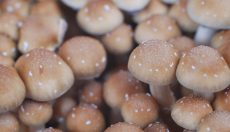
What mushroom aborts are, why they happen, and exactly what to do about them (2026 Update)
You open your grow kit, ready for a full flush of mushrooms, and notice something strange — dozens of tiny, stunted pins that stopped growing midway. Some have dark, shrivelled caps. Others simply froze in place and never developed. These are mushroom aborts, and almost every grower encounters them eventually. The good news is that aborts are rarely a disaster. In most cases, they are a signal — and once you understand what they are telling you, you can act on it.
In this guide: What mushroom aborts are, the most common reasons they happen, whether aborts are safe to use, and a clear action plan for reducing them in future flushes.
Whether you're using a grow kit or cultivating from scratch, this guide gives you the tools to diagnose and respond to aborts confidently.
What Are Mushroom Aborts?
Mushroom aborts — sometimes called aborted pins — are primordia (young mushroom pins) that began to develop but stopped before reaching maturity. They never grow into full fruiting bodies. Instead, they stall at a small size, and their caps often darken, wrinkle, or shrivel over time.
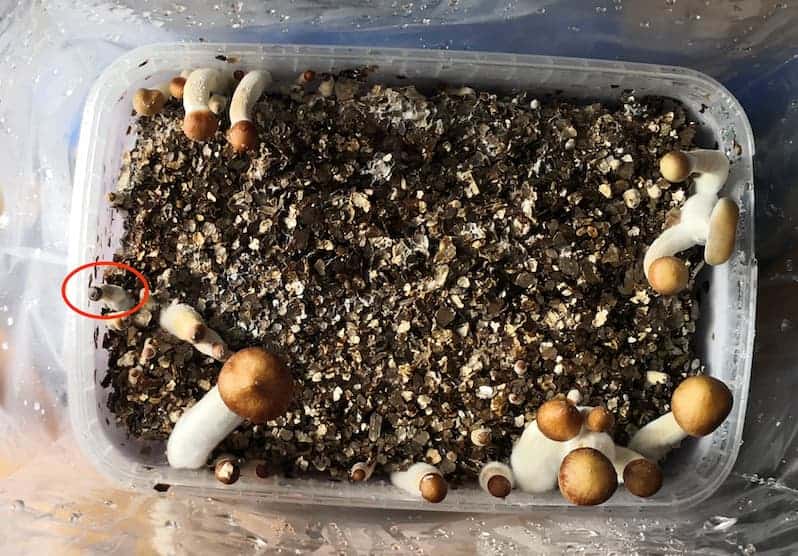
Aborts are a normal part of mushroom cultivation. Even a healthy, well-managed grow will produce some aborted pins, particularly on the first flush when the mycelium is still calibrating its environment. However, when aborts become frequent or the majority of your pins are aborting, that is a sign something in the growing conditions is off.
The key thing to understand is that a mushroom aborts because the mycelium "decided" the conditions were not suitable to support full development. The pin started forming, then the mycelium withdrew resources from it. This can happen for environmental reasons, biological reasons, or a combination of both.
Why Do Mushroom Aborts Happen?
There are several common causes of mushroom aborts, and identifying the right one will point you toward the right solution. In practice, multiple causes can overlap.
Low Humidity
Mushrooms are approximately 90% water. Young pins are especially vulnerable to drying out, because their surface area is large relative to their mass. When humidity drops below around 85%, developing pins may lose moisture faster than they can take it up, causing them to stall and abort.
If you notice your grow kit's substrate surface looks dry, or there is little condensation on the walls of your growing chamber, low humidity is the most likely culprit. Mist lightly and more frequently, aiming for a fine layer of condensation on the inside surfaces — but never allow water to pool on the substrate itself.
Poor Air Exchange — High CO₂
Mushrooms need fresh air. They take in oxygen and release CO₂, and if CO₂ builds up inside a closed container, conditions become unfavourable for healthy development. High CO₂ causes pins to produce elongated, thin stems and tiny caps — and in many cases, they abort entirely before reaching any usable size.
Fresh air exchange (FAE) is one of the most commonly overlooked factors in home cultivation. Fan your grow kit with a clean piece of card twice a day if you are not using a fruiting chamber with proper ventilation. If you notice consistently long, thin stems across your flush, FAE is likely the issue.
Temperature Fluctuations
Sudden temperature changes can shock developing pins. Most Psilocybe cubensis strains thrive at a stable temperature between 22–26°C. If your grow kit sits in a spot with significant day-night temperature swings — near a window, a radiator, or an air conditioning vent — the fluctuations can interrupt pin development and trigger aborts.
Consistency matters more than the exact temperature. Find a stable spot in your home away from direct sunlight and temperature extremes, and your mushrooms will thank you for it.
Contamination
Moulds and bacteria compete with the mycelium for nutrients. When contamination takes hold — even partially — the mycelium may redirect its resources away from fruiting and toward defending the substrate. This often shows up as aborted pins combined with unusual colours (green, black, or pink patches) on the substrate.
If you suspect contamination, act quickly. Remove the grow kit from your growing area immediately and dispose of it safely. Mould spores spread rapidly and can affect other grows nearby. For more detail on identifying and managing contamination, see our full guide on grow kit contamination.
Important: If you see green, black, or pink patches on your substrate alongside aborts, assume contamination. Remove the kit from your growing area immediately and do not try to salvage it.
Overcrowding and Pin Competition
When a flush produces a very large number of pins simultaneously — overpinning — those pins compete for the same limited resources in the substrate. The mycelium cannot support full development of every single pin, so some are sacrificed. This is a biological triage process: the weakest pins abort so that stronger ones can develop fully.
Some strains are more prone to overpinning than others, and the first flush often has the densest pin sets. This type of aborting is the least concerning — it is simply nature selecting the strongest pins. Removing the aborts promptly allows the resources to flow more efficiently to the remaining mushrooms.
Overwatering
Standing water on the substrate surface or inside the growing container suffocates developing pins. Mushrooms need moisture in the air, not pooled water on their base. Overwatering can also promote bacterial growth, further stressing the mycelium.
If water pools in your growing container, tilt it gently to drain the excess. Always mist lightly — aim for fine droplets on the walls, not a soaking wet substrate.
Are Mushroom Aborts Safe to Use?
Aborted mushrooms are generally safe to harvest and use, provided there is no sign of contamination. In fact, aborts often contain psilocybin — sometimes in significant concentrations. Because the mushroom stopped growing before it could convert all its psilocybin into other compounds, aborts can sometimes be quite potent relative to their small size.
However, this does not mean aborts are always worth harvesting. If the abort looks dark, slimy, or smells off, discard it. If contamination is visible anywhere on the substrate, do not eat any mushrooms from that kit. When in doubt, throw it out.
If your aborts seem to have little or no effect despite looking clean, you may be dealing with a different issue. Our article on dud flushes and why some mushrooms have no effect explores this further.
Tip: Harvest aborts as soon as you notice them — before they begin to decompose. Remove them cleanly with clean hands or tweezers to prevent them from spreading moisture and bacteria to healthy pins nearby.
What to Do When You Have Aborts
Here is a practical step-by-step response when aborts appear in your grow.
1
Remove the aborts immediately
Remove the aborts immediately
Pick out all aborted pins as soon as you notice them. Leaving them in place allows them to decompose, which introduces moisture and bacteria that can compromise healthy pins. Use clean hands or clean tweezers and dispose of the aborts away from your growing area.
2
Check your humidity
Check your humidity
Look at the walls of your growing chamber. There should be a light layer of condensation. If they look dry, mist lightly and increase misting frequency. If there is standing water on the substrate, you are overwatering — tilt to drain and reduce misting.
3
Fan for fresh air exchange
Fan for fresh air exchange
Fan the container with clean card or a small fan for 30–60 seconds. Do this at least twice a day. Good air exchange is one of the most effective ways to reduce aborts and encourage healthy pin development.
4
Check for contamination
Check for contamination
Inspect the substrate carefully. If you see unusual colours (green, black, pink, or orange patches) or notice a sour, off smell, contamination may be present. In that case, remove the kit from your growing space and dispose of it safely. See our contamination guide for identification help.
5
Stabilise temperature
Stabilise temperature
Move your grow to a stable location away from windows, radiators, and draughts. Consistent warmth (22–26°C is ideal for most strains) encourages steady, healthy growth with fewer aborts.
Preventing Aborts in Future Flushes
Prevention is simpler than correction. Once you have addressed the immediate issue, carry these habits into your next flush:
Learning to grow your own magic mushrooms well takes some trial and error, but understanding aborts is one of the most useful skills a grower can develop. Once you can diagnose them accurately, you are already most of the way to a cleaner, fuller flush.
For a broader introduction to mushroom cultivation, our guide on Psilocybe cubensis covers strain selection, substrate, and fruiting conditions in detail.
Ready to start growing? Browse our magic mushroom grow kits — everything you need for a successful first flush, delivered to your door.
Note: If you are suffering from a mental illness and are curious about using psilocybin or any other psychedelic therapy, please consult one of the relevant medical authorities first. Do not self-prescribe — it is vital to have the right support and guidance when using psychedelics as medicine.


February 28, 2026