
Votre panier est vide.

Psilocybin Microdosing Guide: How to Start, Schedule, and Track Your Practice
Publié sous: Trip Guides & Preparation

Psilocybin Microdosing Guide: How to Start, Schedule, and Track Your Practice
(2026 Update) — A practical step-by-step companion for beginners and curious explorers
In this guide: This psilocybin microdosing guide covers everything you need to start your practice — from setting a clear intention and preparing your microdose to choosing a schedule and keeping a useful diary.
You already know what microdosing is. This post is about how to do it well. We walk through each step so you can approach your practice with confidence and consistency.
Already curious about the basics? Read our what is microdosing intro first, then come back here for the practical steps.
Step 1: Set Your Intention
Before you prepare a single dose, take time to ask yourself one simple question: what do you want from this practice? Microdosing without a clear intention is like starting a gym routine without knowing what you are training for. You may still see results, but you are unlikely to get the most from the experience.
Common intentions include improved focus and creative thinking, more emotional balance, reduced anxiety, better energy levels, or simply a deeper curiosity about how your mind works. There is no wrong answer — but being specific matters. Instead of "I want to feel better," try "I want to notice whether my concentration at work improves in the morning hours."
Write your intention down before you begin. This gives you a clear reference point when you review your diary later.
Tip: Keep your intention realistic and measurable. A vague goal is hard to track. A specific one gives you something concrete to observe.
Step 2: Choose Your Source — Truffles or Dried Mushrooms?
This psilocybin microdosing guide focuses on two common sources: magic truffles and dried psilocybin mushrooms. Both contain the same active compound — psilocybin — but they differ in consistency and availability.
| Source | Consistency | Availability | Best for |
|---|---|---|---|
| Magic truffles | High — fresh truffles have predictable potency | Legal and available in the Netherlands | Beginners who want reliable results |
| Dried mushrooms | Varies — potency differs between batches and species | Requires a reliable source and a precise scale | Experienced users who grow their own |
For most beginners, magic truffles are the more practical choice. Their moisture content is consistent, which makes it easier to keep your doses uniform from session to session. If you use dried mushrooms, a precision scale that reads to at least 0.01g is essential — small variations can produce noticeably different effects.
To learn more about psilocybin mushrooms in general, visit our guide on what magic mushrooms are.
Step 3: Prepare Your Microdose
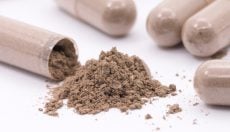
Consistency is the foundation of a good microdosing practice. The goal at this stage is to prepare a batch of uniform doses so you are not weighing out a fresh amount every time you microdose.
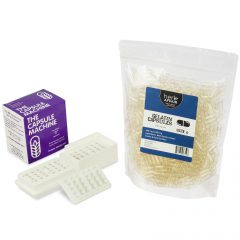
The most practical method is the capsule approach:
For a detailed walkthrough on making capsules, see our guide on how to make your own magic mushroom capsules.
Tip: Label your capsule container with the date of preparation and the source material. Potency fades over time — freshly prepared batches are more reliable.
Step 4: Find the Right Amount for You
This is the most personal part of any psilocybin microdosing guide. There is no universal amount that works the same for everyone. Body weight, sensitivity, metabolism, and the potency of your source material all play a role.
The core principle is simple: a microdose should be sub-perceptual. That means you should not feel "high," see visual effects, or feel significantly altered. If you notice any of those things, your amount is too high. The target is a subtle shift — a little more clarity, a slightly lifted mood, or a quiet increase in focus — without any noticeable impairment.
Start at the lower end of what feels reasonable, then observe carefully over two or three sessions before adjusting. If you feel nothing at all after a few sessions, increase slightly. If effects are noticeable in a way that feels distracting, reduce the amount. Adjust gradually — small steps in either direction.
Two well-known researchers have published frameworks for thinking about amounts. James Fadiman, whose Fadiman Protocol is discussed below, suggests starting very conservatively and only adjusting after consistent observation. Paul Stamets, known for the Stamets Stack, takes a similar sub-perceptual approach but combines it with additional supplements — always at amounts that remain below the threshold of psychedelic effects.
Important: Never increase your amount rapidly or take more because you feel nothing on day one. Sub-perceptual effects are subtle by design. Give each amount at least two full cycles before changing anything.
Step 5: Choose Your Microdosing Schedule
A consistent schedule prevents tolerance from building up and helps you observe effects clearly. Taking psilocybin every day is not recommended — tolerance develops quickly, and rest days are a key part of an effective practice.
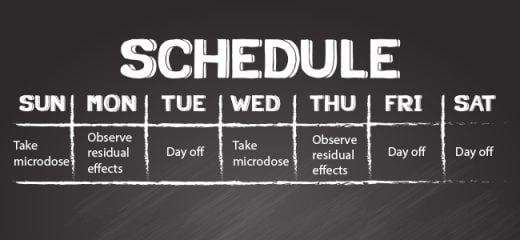
Three schedules are commonly used:
| Schedule | Pattern | Best for |
|---|---|---|
| Fadiman Protocol | 1 day on, 2 days off — repeat | Beginners; structured and easy to track |
| Stamets Protocol | 4 days on, 3 days off — repeat | Those seeking more frequent effect windows |
| Intuitive / as-needed | Take only on days when you feel it is right | Experienced users with good self-awareness |
The Fadiman Protocol — named after researcher James Fadiman — is the most widely documented schedule. The two rest days between doses prevent tolerance and give you clear comparison days, which makes tracking easier. Most newcomers to this psilocybin microdosing guide find it the most manageable place to begin.
The Stamets Protocol involves four consecutive dosing days followed by three rest days. Some people find this gives them a longer window of benefit each week. However, because the on-days are consecutive, any unwanted effects also persist longer — so it is better suited to those who have already spent a few weeks with the Fadiman schedule.
The intuitive approach works well for experienced practitioners. However, without a fixed structure it is easy to overdose on dosing days or let the practice drift. It is therefore not recommended as a starting point.
Step 6: Keep a Microdosing Diary
A diary is, in many ways, the most important tool in this entire guide. Without one, you are relying on memory and general impressions — neither of which is reliable over a period of weeks. With one, you can spot patterns, identify optimal amounts, and make informed decisions about whether to continue, adjust, or stop.
Track the following each day — including rest days:
Review your diary at the end of each week. First, look at dosing days versus rest days — do you notice any consistent differences? Next, compare week one to week two. If effects are positive and stable, your amount and schedule are working. If you notice diminishing returns or unwanted effects, it is time to adjust.
Tip: A simple notebook works just as well as a dedicated app. The important thing is that you write entries on the same day — not retrospectively. Memory fills in gaps in ways that undermine accurate tracking.
For broader context on how psilocybin interacts with the mind, our article on mushrooms and the mind is a useful companion read.
Step 7: Know When to Stop or Take a Break
Microdosing is not a lifelong commitment. Most practitioners run a structured protocol for four to eight weeks, then take an extended break — often four weeks or more — before deciding whether to continue. This rest period helps reset tolerance and gives you a clear before-and-after picture.
Stop or pause your practice if you notice any of the following:
Furthermore, if you are taking any prescription medication — particularly SSRIs or other serotonin-active drugs — consult a doctor before starting. Psilocybin and SSRIs interact through the same receptor pathways, and combining them without medical guidance is not advisable.
For a broader look at dosage thinking applied to full experiences, our magic mushroom dosage guide offers helpful context on sub-perceptual versus active ranges.
Ready to start your practice? Browse our microdosing products — including consistent, ready-to-use magic truffles ideal for a reliable psilocybin microdosing guide practice.
Note: If you are suffering from a mental illness and are curious about using psilocybin or any other psychedelic therapy, please consult one of the relevant medical authorities first. Do not self-prescribe — it is vital to have the right support and guidance when using psychedelics as medicine.


Février 25, 2019