
Votre panier est vide.

Help! My magic mushroom grow kit is contaminated!
Publié sous: Growing & Cultivation
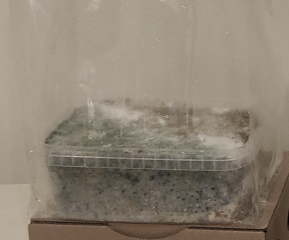
Learn how to recognize healthy mycelium, spot harmful molds early, and know when to save or discard your grow kit.
Growing magic mushrooms can be educational and rewarding, and a successful harvest can bring you a lot of wonderful experiences.
Because grow kits are natural products, you always need to watch out for contamination. In this guide you will learn what is normal, what is dangerous, and what to do in each situation.
| Main risks | Trichoderma (white/green mold), cobweb mold, bacteria, other colored molds. |
| Early warning signs | Strange smells, fast-spreading fuzzy patches, unusual colors, slimy spots, black or dark green areas. |
| Never do this | Never eat mushrooms from a contaminated kit, never ignore foul smells, never keep a clearly infected kit near healthy ones. |
| When to contact support | As soon as you suspect contamination or notice off smells, colors, or textures. Always contact support before throwing the kit away. |
Good white mold: healthy mycelium
Your mushroom grow kit is getting to the fruiting stage and you start to see white mold coming out. There are 2 types of white mold.
One of them is a good “mold” coming from the magic mycelium itself. This is a sign that your mycelium is active and getting ready to produce mushrooms. See fluffiness on the substrate for more info.
The other one can be harmful contamination, which you will read about further down this page.
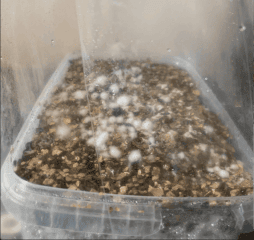
If your kit looks like the image above, that is a good sign: it is the start of the fruiting stage, and from these little mycelium spots the mushrooms will start popping out soon.
Is your kit not growing? Click here and read more about what to do when your kit is not growing.
Blue bruising vs. contamination
Before we dive into the bad molds, there is one common confusion to clear up first. Many growers see blue or blue-green discoloration on their mycelium or mushrooms and immediately think it is contamination, but in most cases it is not.
Blue or blue-green bruising is a natural reaction caused by the oxidation of psilocybin, often after the mycelium is touched, misted with water, or during harvesting. The mycelium usually recovers within 2–3 days and this bruising is completely harmless.
The Q-tip test: Gently press a clean cotton swab against the discolored area. If color transfers to the swab, it is likely mold spores (contamination). If nothing transfers, it is just bruising and nothing to worry about.
Yellow liquid on your kit: mycelium metabolites
Another thing that often worries growers is the appearance of a yellow, orange, or brownish liquid on the surface of the mycelium or at the bottom of the bag. This is commonly known as mycelium metabolites, sometimes called “myc piss” or “mushroom pee” in the growing community.
There is usually no reason to panic. Mycelium metabolites are a natural byproduct of the fungal metabolism and consist of enzymes, acids, and antibiotics that the mycelium secretes as part of its defense.
When is it normal?
When should you be concerned?
Common causes of metabolite production include over-misting, temperature fluctuations, direct sunlight, and the mycelium naturally fighting off minor bacterial threats. In most cases you can leave the metabolites alone and continue your grow as normal, but if you notice a foul smell or slimy texture alongside the liquid, contact customer support.
How to detect contamination early
Contamination is not always visible right away, and in many cases your nose will warn you before your eyes do. Here is what to pay attention to.
If something smells off, contact customer support even if the kit still looks visually normal. The sooner contamination is caught, the better the chances of saving your grow.
Bad white and green mold: Trichoderma harzianum
The other type of white mold is caused by the fungus Trichoderma harzianum, which goes through two visible stages: first white, then green. In its early vegetative stage it looks like in the image below.

When Trichoderma harzianum gets into your grow kit, it will show up as a small white spot and start to spread rapidly. It usually takes over the complete kit in one or two days and causes soft rotting of the substrate.
As the mold matures, it enters its sporulation stage and turns a distinctive green color. Once you see this green mold appear, your kit is unfortunately lost; scooping the bad parts away rarely solves the problem, and the mold often returns within days.
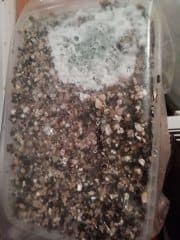
Important: If you see green Trichoderma on your kit, move it away from other grow kits immediately to reduce the risk of spores spreading in the room.
Bad grey mold: cobweb (Cladobotryum spp.)
Grey mold, commonly known as cobweb, is caused by a group of closely related parasitic fungi in the genus Cladobotryum (such as Cladobotryum dendroides and Cladobotryum mycophilum). It grows very fast and looks like a big puffy cloud that seems to float just above the substrate.
Unlike many other molds, cobweb is a parasite that specifically feeds on mushroom mycelium rather than only competing for nutrients.
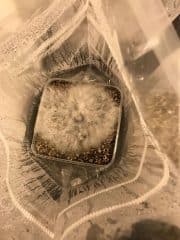
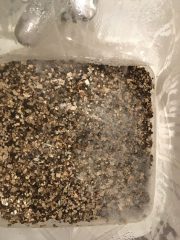
After you have contacted customer support, or if you are sure your kit has a cobweb contamination, you can try to treat it with hydrogen peroxide (H2O2). Hydrogen peroxide is available at pharmacies as a disinfectant and is also used in hair dye products.
How do I get rid of cobweb mold?
1
Prepare your hydrogen peroxide
Prepare your hydrogen peroxide
You can use standard 3% hydrogen peroxide and pour it into a clean spray bottle that can produce fine droplets. Do not dilute it further; at 3% it is strong enough for cobweb but mild enough for your kit.
2
Spray the affected area
Spray the affected area
Spray the 3% hydrogen peroxide directly in fine droplets on the cobweb. You should see the cobweb shrink and disappear shortly after spraying.
3
Repeat if necessary
Repeat if necessary
If the cobweb returns the next day, you can repeat the process. At 3% concentration, hydrogen peroxide is not harmful to your health and breaks down into water and oxygen.
4
Improve fresh air and humidity
Improve fresh air and humidity
To help prevent cobweb from returning, increase fresh air exchange around your grow kit and avoid overly humid, stagnant conditions. Hydrogen peroxide may temporarily slow down healthy mycelium growth, but this is normal and the mycelium can recover.
Other contaminations to watch out for
While Trichoderma and cobweb are the most common problems, there are a few other contaminations you might encounter in a grow kit.
If you are unsure what type of contamination you have, please contact customer support with a clear photo so they can help you identify it.
Can I still eat mushrooms from a contaminated kit?
No, you should never consume mushrooms that grew on or near contaminated substrate.
Contaminants like Trichoderma, Aspergillus, and various bacteria can produce mycotoxins and other harmful compounds that are invisible to the naked eye but can cause serious health issues.
Even if the mushrooms themselves look healthy, the contamination has been in direct contact with the mycelium network that feeds them. When in doubt, throw it out and prioritize your health.
How to prevent contamination
Prevention is always easier than dealing with a contaminated kit. Follow these basic hygiene steps to reduce the chance of contamination during the whole grow.
Consistently following these steps will greatly reduce your chances of running into contamination issues during the life of your grow kit.
Do you have other healthy grow kits?
If you suspect contamination, move the contaminated grow kit to a different room from other grow kits as soon as possible. This lowers the risk of cross-contamination by airborne spores.
Contact us, but do not throw away the kit
When you see contamination, please contact customer support by submitting a ticket here. Do not throw away the kit before speaking with support, as they may still be able to help you.
Please contact customer support within 21 days after starting your kit. The sooner you contact them, the sooner they can help and assess whether replacement or further troubleshooting is possible.
Have a good grow! Team MMS


Mars 1, 2026