
Votre panier est vide.

Tripper seul aux champignons magiques : le guide de sécurité honnête (2026)
Publié sous: Guides de trip & préparation
Guides de trip & préparation · 10 min de lecture
Faire un trip en solo aux champignons magiques est l'un des sujets les plus débattus dans la communauté psychédélique. Certains psychonautes expérimentés ne jurent que par ça. La plupart des experts en réduction des risques le déconseillent fortement, surtout aux débutants.
Ce guide ne te dit pas quoi faire. Il te donne une vision honnête : dans quels cas un trip en solo peut être envisageable, quels sont les vrais risques, comment te préparer si tu choisis d'y aller seul(e), et quelles situations le rendent vraiment dangereux.
Tripper seul(e) aux champignons magiques, c'est vraiment courant ?
Plus courant que la plupart des gens ne l'admettent. Une enquête nationale de 2026 de l'UC San Diego estime qu'environ 8 millions d'Américains ont consommé de la psilocybine rien qu'en 2024, la grande majorité en dehors de tout cadre clinique ou accompagné. La plupart de ces trips se sont déroulés sans trip sitter. Tripper seul(e) aux champignons magiques n'est pas un cas marginal : c'est statistiquement la norme pour un usage récréatif.
Cela ne rend pas la pratique sûre pour autant. Cela signifie simplement que les conseils de réduction des risques doivent s'adresser aux gens là où ils en sont réellement, pas là où les recommandations voudraient qu'ils soient. C'est exactement ce que fait ce guide.
Ce que disent les experts : une position claire mais nuancée
La position du Fireside Project, l'une des principales organisations de réduction des risques psychédéliques, est directe : « Ne fais pas de voyage à dose modérée ou élevée sans un(e) ami(e) sobre à proximité. » Le Center for the Science of Psychedelics de l'UC Berkeley abonde dans ce sens : « Si tu comptes y aller en solo, aie un plan de soutien. »
En même temps, une étude de 2025 publiée dans le Harm Reduction Journal a montré que la préparation psychologique et des stratégies de réduction des risques bien pensées réduisent nettement l'incidence des bad trips, qu'un sitter soit présent ou non. Selon les recommandations de Johns Hopkins, une bonne préparation suffit à elle seule à réduire jusqu'à 70 % le risque de bad trip. Un trip en solo bien préparé est donc nettement plus sûr qu'un trip en solo improvisé.
Pour les tout débutants : ne fais pas ton premier trip seul(e). Tu n'as aucun point de repère sur ce que la psilocybine fait à ta perception, à tes émotions et à ton sentiment de réalité. Un trip sitter de confiance n'est pas optionnel pour une première expérience.
Quand un trip en solo peut être envisageable
Les psychonautes expérimentés qui choisissent de tripper seuls ne sont pas imprudents par définition. Il existe des situations où y aller en solo est un choix réfléchi et éclairé. Tripper seul(e) aux champignons magiques présente généralement moins de risques quand :
- Tu as déjà fait plusieurs trips et tu sais comment la psilocybine agit sur toi personnellement
- Tu prends une dose faible à modérée, généralement 1 à 2 grammes de Psilocybe cubensis séchés
- Tu es dans un état mental stable et positif : pas en plein deuil, rupture, burn-out ou dépression active
- Tu es dans un environnement intérieur sûr et familier, où tu peux fermer la porte à clé et où personne ne viendra te déranger
- Tu n'as aucune obligation en conflit : pas d'appel à passer, pas de conduite, pas d'enfants à garder pendant au moins 12 heures
- Tu as fixé une intention claire pour l'expérience
- Une personne de confiance sait que tu tripes et est joignable par téléphone
La règle du « contact référent » : même si personne n'est physiquement présent, préviens toujours une personne de confiance que tu vas tripper : l'heure du début, la quantité approximative que tu as prise et le moment où elle doit prendre de tes nouvelles. C'est le filet de sécurité minimum pour tripper seul(e) aux champignons magiques.
Quand un trip en solo est vraiment dangereux
Dans certaines circonstances, tripper seul(e) aux champignons magiques comporte des risques sérieux. Ce n'est pas une question de préférence : cela repose sur des données cliniques et des recherches en réduction des risques.
Ne tripe pas seul(e) si l'un des points suivants te concerne :
- C'est ta première fois, point final. Tu ne sais pas comment ton esprit et ton corps vont réagir.
- Tu prends une dose élevée (3,5 g ou plus de champignons séchés). À ce niveau, la dissolution de l'ego, la perte de repères spatiaux et une forte détresse psychologique peuvent survenir même chez des consommateurs expérimentés. La sécurité physique devient une vraie préoccupation.
- Tu as des antécédents personnels ou familiaux de psychose, de schizophrénie, de trouble bipolaire ou de trouble de la personnalité borderline. La psilocybine peut réellement déclencher des troubles psychiatriques latents.
- Tu traverses une détresse émotionnelle aiguë : traumatisme récent, deuil, anxiété sévère ou idées suicidaires actives.
- Tu es près de l'eau : rivières, lacs, piscines, mer. Lis notre article sur la psilocybine près de l'eau pour comprendre pourquoi ce risque est plus sérieux qu'il n'y paraît.
- Tu es dans un lieu inconnu : location de vacances, forêt, festival. La désorientation dans un espace inconnu pendant un trip à forte dose peut vite dégénérer.
- Tu mélanges avec d'autres substances, en particulier cannabis, alcool ou stimulants. Combiner des substances amplifie chaque risque de façon imprévisible.
Comment te préparer à tripper seul(e) : checklist pratique
Si tu as évalué honnêtement tout ce qui précède et décidé de te lancer, la préparation est essentielle. La différence entre une expérience solo profonde et une expérience effrayante tient presque toujours à la façon dont tu t'es préparé(e), pas aux champignons eux-mêmes.
1
Choisis la bonne dose
Choisis la bonne dose
Pour un trip en solo, reste dans la fourchette faible à modérée. Pour des Psilocybe cubensis séchés, cela veut dire 1 à 2 grammes maximum. Tu vis ainsi une expérience marquante, sans la dissolution totale de l'ego et de la perception qui rend les fortes doses difficiles à gérer seul(e). Pour les truffes magiques, l'équivalent est d'environ 5 à 10 grammes de poids frais.
2
Prépare ton espace la veille
Prépare ton espace la veille
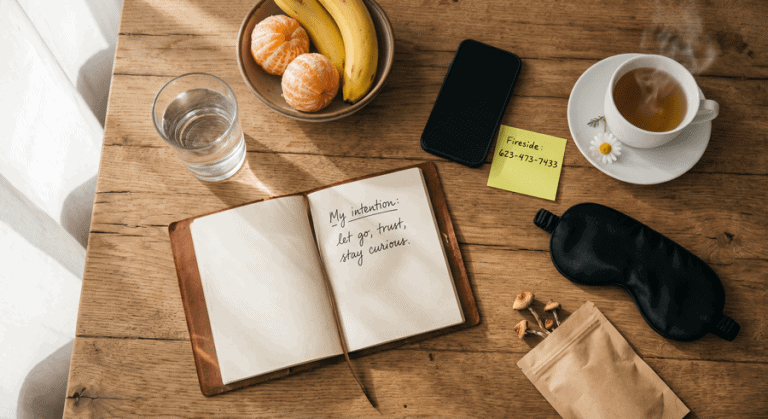
Ton environnement va amplifier tout ce que tu ressens. La veille, range et aménage ton espace. Enlève tout ce qui paraît menaçant ou désagréable : tableaux dérangeants, objets tranchants qui traînent, miroirs si tu es sensible. Prépare des couvertures, des coussins, des vêtements confortables, de l'eau et des petits en-cas (les fruits marchent bien). Prévois des playlists : choisis ce qui te rassure, pas seulement ce que tu écoutes d'habitude.
3
Fixe une intention claire
Fixe une intention claire
Note sur papier, pas seulement dans ta tête, pourquoi tu fais ce trip et ce que tu espères en retirer. Les intentions ne contrôlent pas l'expérience, mais elles te donnent un ancrage. Quand le trip devient intense, relire ton intention écrite peut t'aider à te recentrer et à te rappeler pourquoi tu as choisi de le faire.
4
Préviens quelqu'un et enregistre une ligne d'écoute entre pairs
Préviens quelqu'un et enregistre une ligne d'écoute entre pairs
Informe une personne de confiance. Ensuite, enregistre dans ton téléphone un numéro d'écoute entre pairs avant de commencer. Aux États-Unis, la ligne du Fireside Project est la référence : 62-FIRESIDE (623-473-7433), une ligne gratuite et confidentielle de soutien entre pairs, spécialement dédiée aux personnes qui vivent une expérience psychédélique difficile. Pour l'Europe, il existe d'autres options, détaillées dans la section suivante.
TripSit et autres alternatives européennes à Fireside
L'Europe n'a pas encore de ligne téléphonique unique disponible 24h/24 et équivalente à Fireside, mais la couverture est en réalité très bonne si tu sais où chercher. La ressource la plus importante pour tout tripper solo en Europe est TripSit : un service de chat en direct gratuit, géré par des bénévoles, disponible 24h/24 et 7j/7 via le web, IRC et Discord. Les bénévoles sont formés pour accompagner en temps réel les personnes qui traversent une expérience psychédélique difficile, dans plusieurs langues. C'est l'équivalent fonctionnel le plus proche de Fireside pour quelqu'un qui tripe seul en Europe.
Outre TripSit, plusieurs organisations nationales proposent du soutien :
- ?? Royaume-Uni — PsyCare UK : accompagnement et réduction des risques dans les festivals et événements, avec des bénévoles formés, spécialisés dans la désescalade des crises psychédéliques.
- ?? Irlande — PsyCare Ireland : services d'accompagnement 24h/24 lors d'événements partout en Irlande, avec des espaces sûrs pour les expériences difficiles.
- ?? Portugal — Kosmicare : le pionnier européen, né au Boom Festival en 1997. Propose aujourd'hui un soutien toute l'année en réduction des risques et en intégration.
- ?? Pays-Bas — Unity et Jellinek : soutien entre pairs lors d'événements et tests de drogues anonymes. Jellinek propose aussi un chat en ligne pour les questions hors situation de crise.
- ?? Allemagne — Drogen & Du : ressources détaillées de réduction des risques et conseils en cas de crise, en allemand.
- ?? Espagne — ICEERS : association à but non lucratif basée à Barcelone, avec un programme de soutien à l'intégration psychédélique, particulièrement solide pour le travail post-trip après des expériences de plantes médicinales.
Astuce : avant de commencer ton trip, note à la fois le numéro de Fireside et l'URL de TripSit sur un post-it, que tu colles à côté de l'endroit où tu t'installes. Ne compte pas sur le déverrouillage de ton téléphone quand tu seras en détresse : repère ta source d'aide avant de prendre les champignons.
Quand une crise psychologique aiguë survient
Si un trip solo dépasse le simple moment difficile et tourne à la véritable crise psychologique (idées suicidaires, panique qui ne passe pas, sentiment de perdre le contact avec la réalité), appelle la ligne d'urgence de ton pays. Ces lignes ne sont pas spécialisées dans les psychédéliques, mais elles sont formées, confidentielles, gratuites et disponibles 24h/24 et 7j/7 :
- ?? Pays-Bas — 113 Zelfmoordpreventie : 0800-0113 (gratuit, 24h/24, 7j/7)
- ???? Royaume-Uni et Irlande — Samaritans : 116 123 (gratuit, 24h/24, 7j/7)
- ?? Allemagne — Telefonseelsorge : 0800 111 0 111 (gratuit, 24h/24, 7j/7)
- ?? Belgique — Zelfmoordlijn 1813 : 1813 (gratuit, 24h/24, 7j/7)
- ?? Espagne — Teléfono de la Esperanza : 717 003 717 (24h/24, 7j/7)
- ?? France — 3114, prévention du suicide : 3114 (gratuit, 24h/24, 7j/7)
- ?? Numéro d'urgence européen : 112
5
Ferme la porte à clé et mets ton téléphone à l'écart
Ferme la porte à clé et mets ton téléphone à l'écart
Ferme ta porte d'entrée à clé pour ne pas pouvoir sortir en errant. Mets ton téléphone dans une autre pièce ou dans un tiroir, pas simplement en silencieux. Envoyer des messages ou appeler des gens pendant un trip est l'une des sources les plus fréquentes de gêne, de malentendus et de détresse. L'exception : les contacts Fireside ou TripSit doivent rester accessibles en cas de besoin. Une solution simple consiste à noter sur un post-it le numéro de ton ami(e) de confiance, le numéro de Fireside et l'URL de TripSit, à le placer près du téléphone, et à ranger le téléphone écran vers le bas dans un tiroir.
6
Garde un « trip killer » à portée de main
Garde un « trip killer » à portée de main
Un trip killer est une substance capable de réduire nettement l'intensité d'une expérience à la psilocybine. L'option la plus efficace et la plus accessible est une benzodiazépine (comme le diazépam/Valium ou l'alprazolam/Xanax) : elle atténue la réponse du récepteur 5-HT2A et peut apaiser un trip qui part en spirale en 30 à 60 minutes. Si tu n'as pas d'ordonnance, parles-en à ton médecin traitant avant ton expérience. La vitamine C à haute dose et le poivre noir (bêta-caryophyllène) sont des options naturelles plus douces, parfois utilisées dans la communauté, même si les preuves scientifiques à leur sujet restent limitées.
Que faire quand le trip devient difficile
Les moments difficiles pendant un trip en solo sont normaux : ils ne signifient pas automatiquement que quelque chose a mal tourné. Les recherches de Johns Hopkins montrent de façon constante que les expériences difficiles sont souvent corrélées à de plus grands bénéfices à long terme. L'essentiel est de savoir répondre plutôt que réagir.
Ancre-toi avec la méthode 5-4-3-2-1
Cette technique sensorielle ramène ton attention vers le monde physique. Nomme 5 choses que tu vois, 4 choses que tu touches (sens la texture du sol, de tes vêtements, d'une couverture), 3 choses que tu entends, 2 choses que tu sens et 1 chose que tu goûtes. Fais-le lentement et à voix haute si possible.
Lâche prise, ne lutte pas
Le conseil le plus constant des psychonautes expérimentés comme des chercheurs cliniques est le suivant : la résistance amplifie la détresse. Si l'expérience devient intense, t'allonger, fermer les yeux et laisser l'expérience te traverser, au lieu d'essayer de l'arrêter, mène presque toujours à un résultat plus apaisé. L'expression « lâche prise et fais confiance » revient sans cesse dans la littérature de réduction des risques, et pour de bonnes raisons.
Change doucement d'environnement
Passe d'une pièce à l'autre. Passe de la position allongée à la position assise. Change la musique. Ouvre ou ferme une fenêtre. De petits changements d'environnement peuvent transformer radicalement le ton d'une expérience, sans que tu aies besoin de sortir ni d'interagir avec le monde extérieur.
Demande du soutien si besoin
Contacter TripSit, le Fireside Project ou ton contact de confiance n'est pas un échec : c'est exactement pour ça que ce filet de sécurité existe. Pas besoin d'être en crise pour appeler. Une voix calme au bout du fil, ou un bénévole bienveillant sur un chat, peut suffire à transformer un moment effrayant en quelque chose de gérable.
Quand appeler les secours : si toi ou quelqu'un d'autre présente une forte fièvre, des convulsions, une douleur thoracique intense, ou représente un danger pour soi-même ou pour les autres, appelle immédiatement le 112 (UE) ou le 911 (États-Unis). La psilocybine est physiologiquement très sûre, mais une détresse psychologique à forte dose peut, dans de rares cas, entraîner des comportements dangereux.
Après le trip : le défi de l'intégration en solo
Un aspect sous-estimé du trip solo aux champignons magiques, c'est ce qui se passe après. Sans personne ayant partagé l'expérience avec toi, l'intégration peut sembler plus solitaire et plus difficile à digérer. Les expériences à la psilocybine, surtout les plus profondes ou les plus éprouvantes, gagnent souvent à être verbalisées ou écrites peu de temps après.
Tiens un journal dans les jours qui suivent ton trip. Si quelque chose continue de te sembler irrésolu, envisage d'en parler avec un thérapeute spécialisé dans l'intégration psychédélique : des professionnels qui aident à donner du sens aux expériences psychédéliques sans les pathologiser. Le guide du bad trip de ce blog aborde aussi plus en détail la gestion de l'après-trip.
La fenêtre de l'afterglow : dans les 24 à 48 heures qui suivent une expérience à la psilocybine, beaucoup de gens se sentent particulièrement ouverts, réflexifs et disponibles émotionnellement. C'est le moment idéal pour écrire dans ton journal, faire de l'exercice doux, passer du temps dans la nature et avoir des conversations sincères, pas pour prendre de grandes décisions ni reprendre direct un rythme de travail exigeant.
Le bilan honnête sur le trip en solo
Tripper seul(e) aux champignons magiques n'est pas intrinsèquement imprudent. Pour des consommateurs expérimentés, avec la bonne dose, le bon cadre et la bonne préparation, cela peut devenir une pratique profondément porteuse de sens. Mais cela comporte de vrais risques qu'un trip sitter permet d'atténuer, notamment à doses élevées, pour les premières fois, et pour toute personne vulnérable à la détresse psychologique.
La règle la plus importante est la suivante : ne tripe jamais seul(e) pour la première fois, et ne tripe jamais seul(e) à forte dose. Au-delà de ces deux limites strictes, une auto-évaluation honnête, une préparation rigoureuse et un filet de sécurité, même à distance comme TripSit ou Fireside, font du trip solo aux champignons magiques un risque calculé plutôt qu'un risque inconsidéré.
Si tu veux en savoir plus sur la façon de te préparer de manière responsable, lis notre guide complet sur les 9 étapes pour un trip aux champignons magiques en toute sécurité et notre synthèse sur ce que dit la science sur les risques des champignons magiques.
Prêt(e) à cultiver tes propres champignons chez toi ?
Découvre nos kits de culture de champignons magiques : la façon la plus sûre et la plus fiable de savoir exactement ce que tu consommes.


May 1, 2026